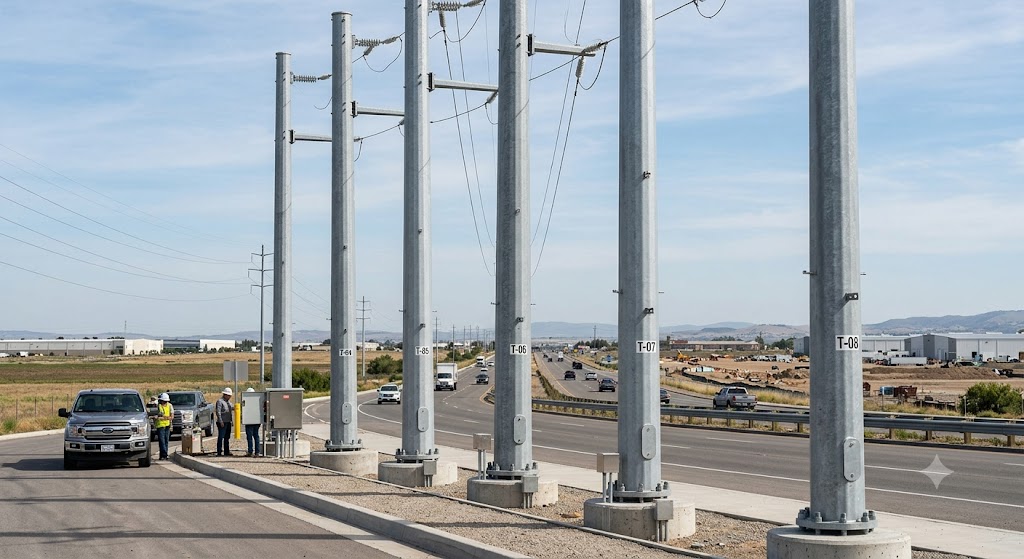

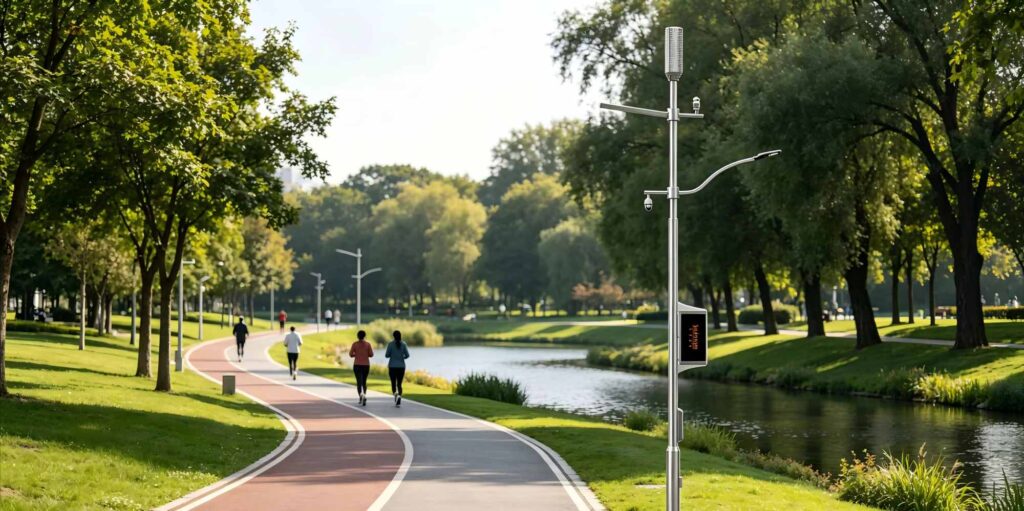
Tapered steel poles generally offer better structural integrity. Their shape handles bending and wind loads better than a straight shaft. This matters to engineers, facility managers, and procurement teams who choose poles for real projects. A pole that bends too far can crack fixtures or fail outright. The comparison below covers wind resistance, bending stress, deflection, fatigue, and weight efficiency. Morelux brings over 15 years of custom steel pole manufacturing to these structural comparisons. The company builds poles to BS EN, AASHTO, AS/NZS, and MS standards. That production experience shapes every point that follows.
Key Takeaways
- Tapered poles deal with wind and bending forces better than straight poles do.
- Tapered poles use less material and stand up to wind better.
- Straight poles work well for short distances and budget-friendly light fixtures.
- Morelux provides custom pole designs and wind load analysis for your project.
- Pick the right pole shape for your site’s wind and load needs.
What Is the Difference Between Straight and Tapered Steel Light Poles?
A light pole works as a vertical cantilever. The base is fixed. The top is free. Wind pushes against the shaft. This force creates a bending moment. The bending moment is highest at the base. It drops toward the top. Engineers describe this with a simple relationship:
- Bending moment at distance x: M(x) = -1/2 · q · x²
- Maximum bending moment at the fixed base: M_max = -1/2 · q · l²
Here q is the uniform load per unit length. The letter l stands for the cantilever length. Deflection is the lateral displacement under wind load. Too much deflection can crack fixtures or exceed code limits. Wind force is dynamic pressure. It rises with height and exposure. Pole shape affects the drag coefficient. Fatigue comes from repeated wind-induced vibration cycles. These cycles can cause cracking over decades. Shorter poles face stricter sweep limitations. Minor deviations impact their structural performance more. Longer poles accommodate more deviation.
How Straight Steel Light Poles Distribute Loads Along the Shaft
A straight pole keeps the same diameter from base to top. The section modulus stays constant along the full height. This design is simple and cheap to manufacture, cut, and weld. Accessories mount easily at any height. The weakness is structural. Bending stress near the base is higher than necessary for the load. The larger average diameter also creates more wind resistance along the full height. Square straight aluminum anchor base poles are less resistant to wind than tapered poles. Their flat sides catch more force.
How Tapered Steel Light Poles Change Diameter Along the Shaft
A tapered pole shrinks in diameter from base to top. The shaft is a one-piece assembly with a constant linear taper.
The pole shaft is a one-piece assembly with a constant linear taper of 0.11 in/ft (approximately 9.17 mm/m).
Taper ratios vary by application. Residential low-pole and courtyard lights (2–4 m) use 2–4 mm/m. Municipal road street lights (5–12 m) use 5–8 mm/m. High-mast streetlights (9–12 m) use 7–8 mm/m. Very tall high-mast lights (15–40 m) use 8–12 mm/m. Special conditions like coastal typhoon zones add 1–2 mm/m above standard. This shape places more material near the base. That is where bending stress is highest. The smaller top diameter reduces wind-exposed area. Total wind load and deflection drop as a result.
How Does Pole Shape Affect Structural Integrity and Load Capacity?
Shape decides how a pole carries its load. A straight shaft has one diameter from bottom to top. This even cross-section is simple and low-cost to cut and weld. Accessories mount easily at any height. But the design has a structural weakness: a constant diameter means the section modulus does not change. Bending stress near the base stays higher than the load needs. The bigger average diameter also creates more wind resistance for the whole height.
How Shaft Geometry Influences Bending Stress and Deflection
The cross-section shape changes how wind hits the pole. Drag coefficient changes with shape. A lower drag coefficient means the wind pushes less. Projected area is the part of the fixture that faces the wind. Drag factor tells how hard wind pulls a fixture based on its shape. Sharp corners create more drag than rounded corners. Effective projected area combines these two values: EPA = A × Cd, where A is projected area and Cd is drag coefficient.
| Cross-sectional shape | Effect on projected area / drag |
|---|---|
| Square poles | Larger EPA than round poles |
| Poles with sharp corners | More drag than rounded fixtures, resulting in a higher drag factor |
| Round poles | Smaller EPA than square poles |
Round tapered poles usually handle wind better than poles with large flat surfaces.
Square straight aluminum anchor base poles handle wind poorly. Their flat sides catch more force than a tapered round shaft.
How Wall Thickness and Steel Grade Affect Pole Strength
Wall thickness sets how much load a pole can carry at each height. For Q235B steel, a 3–4 m pole needs 2–2.5 mm. A 6–8 m pole needs 3–4 mm. A 10–12 m pole needs 4–5 mm, which works in windy areas. Thicker walls add strength, cost, and weight. In hurricane zones, 4–5 mm walls with a larger 70/180 mm diameter are recommended. A 6 m Q235B pole with 3.5 mm walls and 60/150 mm diameter can handle 120 km/h winds with a 0.5 m² solar panel.
Material choice also matters. Steel poles beat aluminum at every height. They have higher tensile strength and thicker walls, so they can carry heavier fixtures without needing to widen the base. At 6 meters, a steel pole supports about 38 kg of luminaire load. Aluminum handles about 22 kg. That gap is over 70 percent. At 16 meters, both drop sharply as base bending moment grows. Highway and stadium mounts often carry 45–60 kg of arm and fixture weight, so engineers should raise wall thickness or lower pole height. Steel suits high-strength work, while aluminum offers corrosion resistance and faster lead times.
How Do Straight and Tapered Light Poles Compare in Wind Resistance?
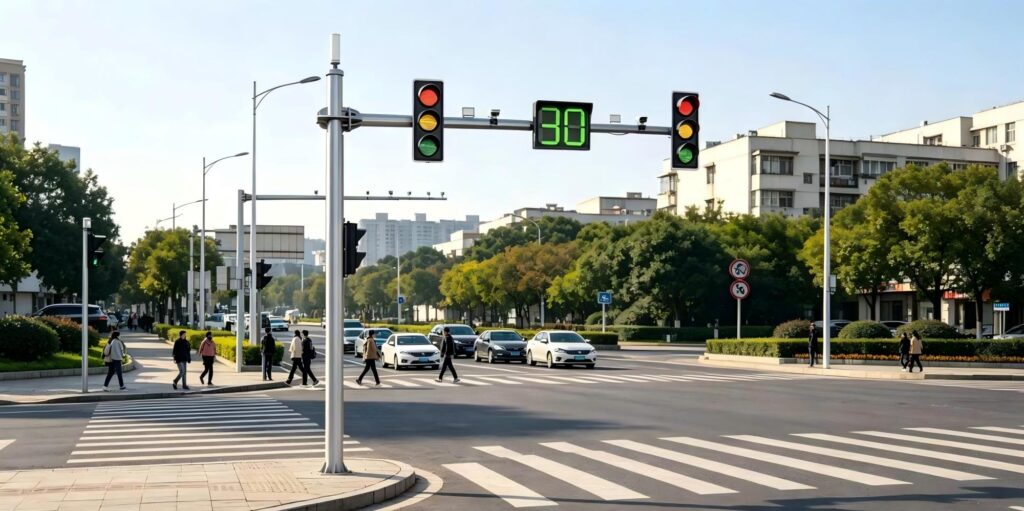
Wind resistance is the biggest difference between these two pole shapes. Tapering puts more material near the base. That is exactly where bending stress is highest. This setup gives a better strength-to-weight ratio. A smaller top diameter also cuts down the wind-exposed area. As a result, total wind load and deflection go down. Tapered poles spread weight and forces more evenly along the shaft. Stability and torsion resistance get better. Harmonic vibrations are much less likely to happen in tapered poles than in non-tapered ones. The downside is making them. Spinning, bending, and welding a tapered shaft is harder to do. The unit cost is higher than a straight pole.
How Pole Shape and Projected Area Affect Wind Loads
Shape decides how wind hits the pole surface. Round surfaces let air flow around them smoothly. Flat surfaces catch the wind and hold onto it. The drag coefficient shows this difference.
| Pole Shape | Drag Coefficient | Relative Wind Resistance |
|---|---|---|
| Round (e.g., round tapered steel) | 0.5 | Baseline (lower resistance) |
| Rectangular/Square (e.g., square straight) | 1.2 | ~60% more wind resistance than round poles of the same size |
A square straight pole gets about 60 percent more wind resistance than a round pole of the same size. That extra force travels down the shaft and builds up at the base. Round tapered poles are suggested for keeping structural integrity in higher wind speeds. The smooth profile lets wind slide off instead of fighting it.
Round, tapered steel poles resist Aeolian vibrations better because wind flows around them more smoothly. Projects in open, flat areas with few buildings or trees to block wind patterns might benefit from steel instead of aluminum for better long-term stability.
How Pole Height and Fixture Loads Influence Wind Performance
Height makes every wind effect stronger. A taller pole puts more surface area in the wind’s path. The bending moment at the base grows with the square of the height. A 12 m pole faces four times the base moment of a 6 m pole under the same wind pressure. Fixture loads add to this demand. A heavier luminaire or solar panel increases the effective projected area. The drag factor of the fixture itself matters too. Sharp corners on a fixture create more drag than rounded ones. Engineers combine these values into the effective projected area: EPA = A × Cd, where A is projected area and Cd is drag coefficient. Tapered poles handle this growing load better at every height. Their wider base gives the section modulus needed to resist the higher moment. Their narrower top keeps the wind-exposed area smaller. Morelux produces tapered, round, octagonal, and hexagonal poles with hot-dip galvanizing, powder coating, and duplex coating for corrosion resistance. These finishes protect the pole surface from long-term environmental attack. That protection keeps wind performance strong over decades of service.
Our Custom Straight and Tapered Steel Light Pole Solutions

Choosing between straight and tapered steel light poles depends on wind loads, pole height, fixture weight, and structural requirements. Tapered poles generally offer a better strength-to-weight ratio and reduced wind exposure, while straight poles can suit projects with simpler load requirements.
| Attribute | Tapered Pole | Straight Pole |
|---|---|---|
| Wind resistance | Narrower top reduces wind exposure | Constant profile may increase wind exposure |
| Strength-to-weight | Material distributed efficiently | Depends on section dimensions |
| Deflection | Stiffer base helps control bending | Depends on wall thickness and design |
| Fatigue performance | Depends on stress distribution and design | Depends on stress distribution and design |
Custom Pole Dimensions and Configurations
MORELUX has over 15 years of experience manufacturing custom steel poles, including round, square, straight, and tapered designs. Buyers can specify pole height, dimensions, wall thickness, base plate, anchor bolt pattern, hand holes, mounting options, and fixture arms to meet project requirements.
Engineering and Wind Load Analysis
Wind load analysis considers pole dimensions, local wind conditions, luminaire effective projected area (EPA), mounting arms, and other attachments. These factors help engineers determine suitable wall thickness and structural specifications. MORELUX provides engineering calculations and technical drawings to support project-specific requirements.
For corrosion protection, hot-dip galvanizing and suitable additional coatings can improve durability in demanding environments. Duplex systems combining galvanizing and paint coatings may be appropriate for C4/C5 exposure, depending on the project specifications.
Frequently Asked Questions About Straight and Tapered Light Poles
Are Tapered Steel Light Poles Stronger Than Straight Light Poles?
Not necessarily. Tapered steel light poles distribute material more efficiently, with a wider base to resist bending forces. Straight poles can also meet structural requirements when properly engineered. The better choice depends on pole dimensions, steel grade, wall thickness, and applied loads.
Which Light Pole Shape Performs Better in High-Wind Conditions?
Tapered light poles can offer structural and aerodynamic advantages because their narrower upper sections reduce wind exposure. However, wind resistance also depends on pole height, diameter, wall thickness, fixture loads, and foundation design. MORELUX evaluates these factors to develop steel poles for project-specific wind conditions.
Does Pole Wall Thickness Matter More Than Pole Shape?
Neither factor should be considered alone. Wall thickness affects structural strength and bending resistance, while pole shape influences load distribution and wind exposure. Both must be calculated alongside steel grade, pole dimensions, and luminaire effective projected area (EPA) to determine the required design.
How Should Buyers Specify Structural Requirements for Light Poles?
Buyers should provide pole height, straight or tapered profile, steel grade, wall thickness, fixture weight and EPA, design wind speed, mounting configuration, and site conditions. Foundation details and applicable standards should also be confirmed. MORELUX offers customized steel light poles with engineering calculations and technical drawings to support project specifications.