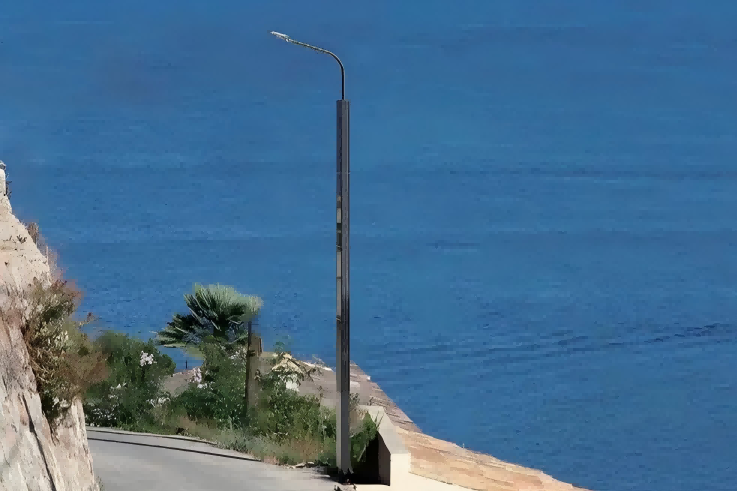
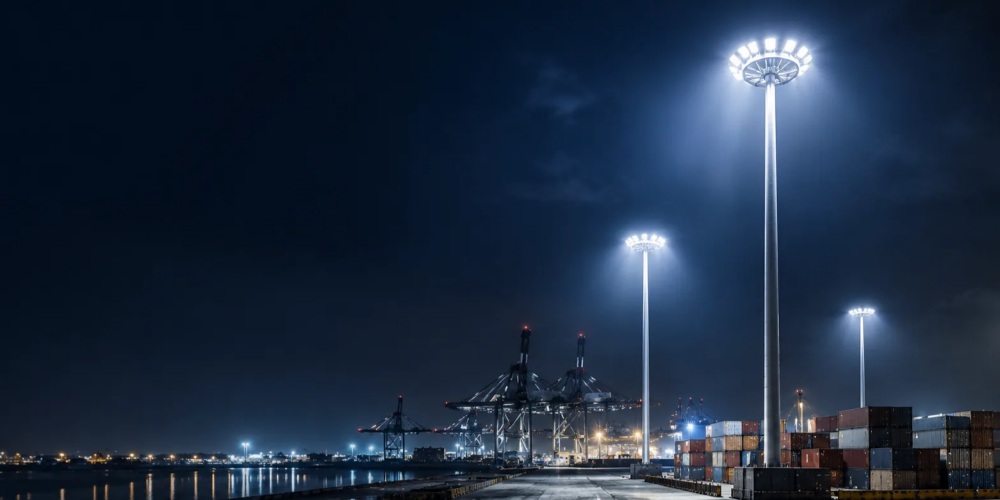
High mast light poles are usually made of steel, aluminum, or fiberglass. Steel is the most common choice for the material of high mast light pole. Each option has its own benefits. The right material for a high mast light pole depends on five key factors. These factors are strength, weight, corrosion resistance, compliance, and cost.
Strength matters most for tall structures. Weight affects how the pole is moved and installed. Corrosion resistance decides how long the pole lasts in harsh weather. Following project standards is a must. Budget shapes the final decision.
No single material works for every project. A coastal site needs different properties than an inland highway. A stadium lighting system carries different loads than a small parking area. Each material has a proper fit. The sections below explain these materials and compare how they perform.
Key Takeaways
- Steel is the most common material for high mast light poles because it is strong and does not bend easily.
- Aluminum and fiberglass are good choices for special needs, like being light in weight or resisting rust.
- Pick the pole material by looking at five things: strength, weight, rust resistance, following the rules, and cost.
- Pick the material that fits your site’s conditions, like coastal areas or cold climates.
- Make sure the material meets the project’s standards, and compare the upfront cost with the long-term upkeep.
What Materials Are Commonly Used for High Mast Light Poles?
Three materials lead the market for tall lighting structures: steel, aluminum, and fiberglass. Steel is the most common material of high mast light pole projects worldwide. Aluminum and fiberglass serve specific needs where their unique properties offer a better fit.
Why Structural Steel Is Widely Used for High Mast Light Poles
Steel offers higher load capacity and stiffness than the other options. Its modulus is roughly 200 GPa, about three times that of aluminum at around 70 GPa. This stiffness keeps tall poles stable under wind loads and heavy luminaire arrays. Steel also delivers strong tensile performance, with typical tensile values of 400–550 MPa.
The trade-off is weight. Steel density sits near 7.85 g/cm³, so a steel pole weighs about three times an aluminum equivalent. Transport and lifting equipment must handle that mass. Galvanized zinc coating protects steel from rust, giving 15–25 years in coastal or salt exposure and 25–50 years inland. Upfront cost is lower than aluminum, which suits budget-driven projects.
Aluminum and Fiberglass for Specialized Pole Applications
Aluminum weighs about one-third of steel, near 2.70 g/cm³, and a 6 m pole comes in around 20 kg. That light weight makes transport and installation easier on sites with limited lifting capacity. Aluminum forms a natural self-regenerating oxide layer, so it needs no coating and often lasts 50+ years. Its upfront price is higher, yet maintenance stays low.
Fiberglass, or FRP, is non-conductive and impervious to rust, pitting, road salt, saltwater, and UV. It withstands winds above 260 MPH and bends without breaking. Material cost is higher, but a 60–70 year service life offsets that outlay over time. Each material fits a distinct role, and the right pick follows project conditions.
What Types of Steel Are Used in Steel High Mast Poles?
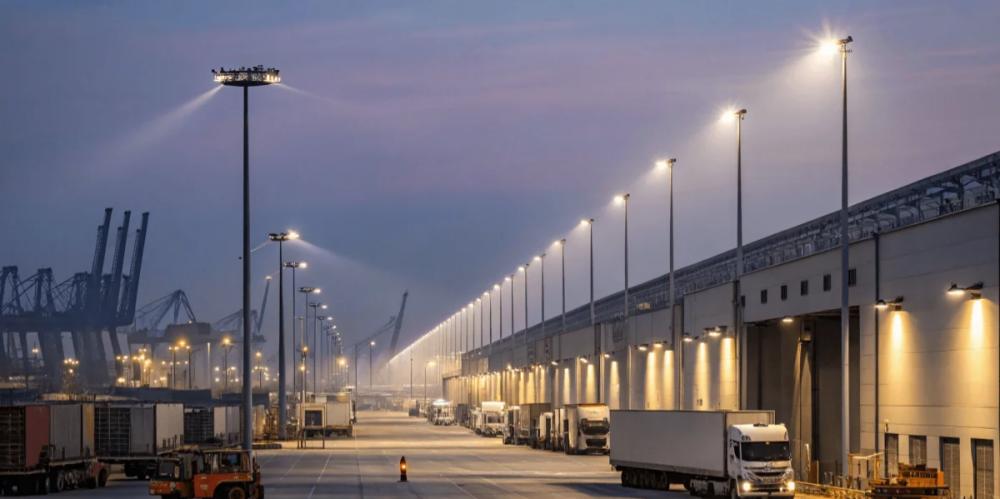
Steel is not just one product. Several steel families are used for tall lighting structures, and each one brings its own mix of strength, weldability, and corrosion resistance. The type of steel you choose shapes how the material of high mast light pole performs over many years of service.
Mild Steel vs High-Tensile Steel for High Mast Pole Applications
Mild steel is the standard choice for most high mast poles. It bends well, welds easily, and keeps building costs steady. Its moderate yield strength works for poles of normal height and moderate light loads.
High-tensile steel raises the yield strength a lot. A pole made from high-tensile steel can hold heavier loads or use a thinner wall for the same job. ASTM A572 Grade 65 shows up in high mast pole bodies, with matching steel used for base plates and support parts.
Stainless steel is used for projects where rust resistance matters most. It fights rust without a zinc coating, which suits very harsh environments. The downside is higher cost, so stainless steel usually shows up in special uses rather than standard highway poles.
Common Structural Steel Grades for High Mast Pole Manufacturing
High-strength structural steel is widely used for polygonal steel shafts. These grades form the tapered or straight polygonal sections that give high mast poles their stiffness. Builders cut, bend, and weld the plate into shape, then join the sections into one shaft.
Surface protection comes after building. Hot-dip galvanizing coats the finished pole with zinc and guards it from rust. ASTM A123 sets the galvanizing practice for outdoor installations. An optional powder coating adds color and a second barrier against weather. Grade selection, coating thickness, and building requirements should match the site environment and the applicable engineering standards.
Steel works for every mounting style. Fixed high mast poles, hinged poles, and poles with lowering devices can all be made of steel. The steel type changes with the design, yet the building route stays familiar to most suppliers.
How Do Steel Properties Affect High Mast Pole Structural Performance?
The Role of Steel Strength and Ductility in Tall Pole Structures
The steel grade decides how a pole acts in wind. S235 or S355 structural steel is common, and stronger steel is used where wind speeds pass 25 m/s. A higher yield strength stops structural failure and keeps the pole within safe deflection limits under peak wind pressure. Ductility plays a second role. Under EN 12767, steel ductility soaks up kinetic energy in Intermediate and High Energy absorption designs. This protects people in vehicles and pedestrians during a crash while the pole keeps its wind-load strength.
Geometry supports these properties. High mast poles for stadiums and ports often reach 25–50 m as multi-sectioned telescopic assemblies. A conical shape spreads stress in a steady linear gradient. This avoids the stress concentration points that can lead to fatigue cracking under repeated wind loading.
Wall Thickness and Shaft Design for High Load-Bearing Capacity
Wall thickness follows wind speed directly. A variable wall thickness plan can cut weight by 20–30% while holding bending moment capacity. Design targets commonly include a 1.5× safety factor, a maximum tip deflection of H/100, a 60 m/s design wind speed, and a 25-year fatigue life.
Shaft geometry matters just as much. Conical or polygonal tapered shafts are standard, with 12–18 sides on polygonal poles and a conical roundness deviation of 5‰ or less. Slip-joint overlap should reach 1.7 times the outside diameter at the larger end, with joint clearance of 3 mm or less after assembly. Sections usually stay under 12 m to fit galvanizing baths and transport.
Aluminum offers a different balance. Its light weight makes transport and installation easier, and it suits fixed, hinged, and lowering-device poles. Steel remains the stiffer option for very tall spans, so the material of high mast light pole should follow the load case, not habit.
What Surface Treatments Protect Steel High Mast Light Poles?
Steel needs a protective layer to resist rust over many years outdoors. Two treatments do most of this work: hot-dip galvanizing and powder coating. Each one protects the pole in a different way.
Hot-Dip Galvanizing for Long-Term Steel Pole Corrosion Protection
Hot-dip galvanizing coats the finished pole in zinc. The zinc layer acts as a barrier and wears away before the steel can rust. For steel light poles, the recommended zinc layer thickness is 70–100 μm. National standards go further and require the zinc layer to exceed 85 μm, applied to both the inside and outside of the pole, smooth and free of defects.
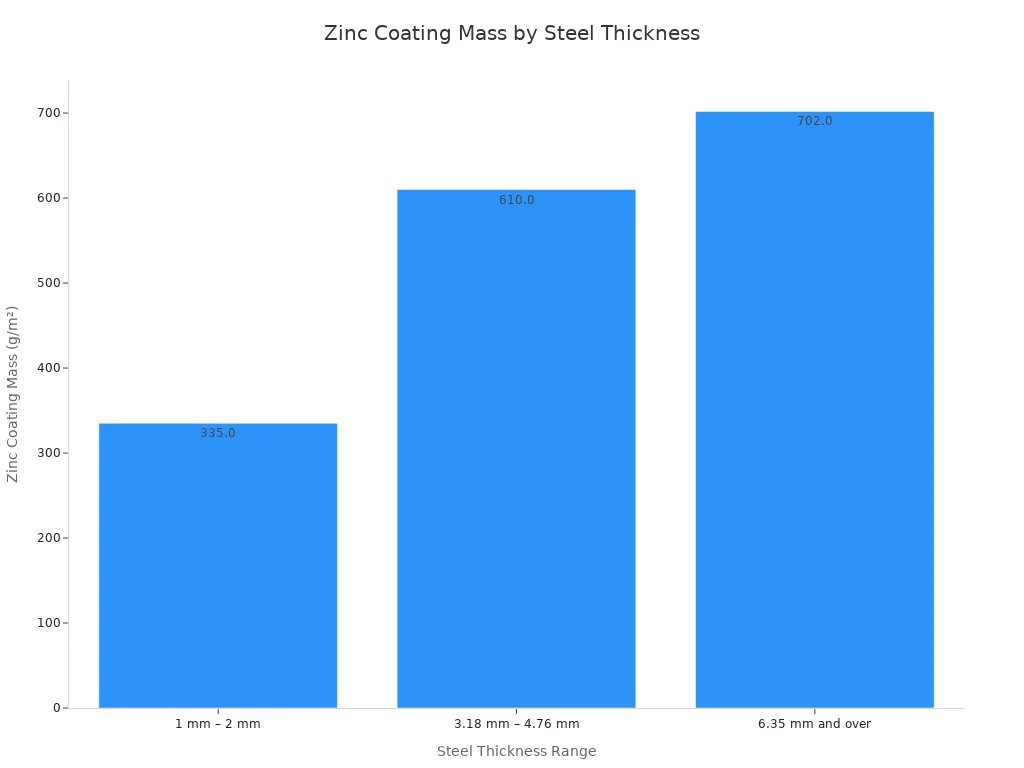
Coating mass depends on steel thickness and the standard applied:
| Standard | Steel Thickness | Zinc Coating Mass |
|---|---|---|
| BS ISO 1461 | 1 mm – 2 mm | 335 g/m² |
| ASTM A123 | 3.18 mm – 4.76 mm | 610 g/m² |
| ASTM A123 | 6.35 mm and over | 702 g/m² |
Inspectors test the coating with magnetic thickness gauges, checking many points on the pole body and flange. Coastal and port sites need thicker heavy-duty zinc coatings. Galvanized layers usually reach 50–150 μm or more, much thicker and more even than electroplating.
Powder Coating for Durable and Weather-Resistant Steel Poles
Powder coating adds color and a second barrier on top of the zinc. It gives a smooth, glossy finish that suits urban and aesthetic projects. Colors resist fading well. Initial processing cost is lower than galvanizing alone.
The trade-offs are clear. Powder coating works well in mild environments, yet it weakens in coastal, salt-mist, and high-humidity areas, and the coating can wear off. It scratches easily and needs touch-ups, and it needs re-coating in extreme weather. Galvanizing lasts decades with minimal maintenance. The best approach often pairs both: galvanize first for corrosion protection, then powder coat for appearance. This combination protects the material of high mast light pole while meeting project finish requirements.
How Does Material Selection Affect High Mast Pole Manufacturing?
The material you pick shapes every part of production, from the machines on the floor to the inspection reports that ship with the pole. The table below sums up the four factors that drive most decisions.
| Factor | Steel | Aluminum | Fiberglass |
|---|---|---|---|
| Strength | High stiffness and tensile capacity | Moderate, lower modulus | Moderate, flexible |
| Weight | Heavy, about 7.85 g/cm³ | Light, about 2.70 g/cm³ | Light |
| Corrosion resistance | Needs galvanizing or coating | Self-protecting oxide layer | Impervious to rust |
| Cost | Lower upfront | Higher upfront, low upkeep | Higher material cost |
Rules add another layer. Projects may require design checks against BS EN, AASHTO, AS/NZS, or MS specs, and the material you choose must have the certificates to prove it meets them.
Steel Cutting, Welding, and Forming in High Mast Pole Production
The material decides the machine. Thicker plate needs more forming force, so the equipment must handle the full material range. Pole height, base and top diameter, wall thickness, and cross-section decide which cutting, forming, and welding stations you need.
Flat plate follows a clear path. CNC plasma or laser cutting makes trapezoidal blanks. A hydraulic press brake forms the polygon or round taper. Then a longitudinal seam is welded along the full pole length. This welded route costs less in tooling and suits low-volume or custom orders.
Seamless extruded tube skips blank cutting. The tube is cut to length, then rotary spun on a CNC lathe, thinning the wall before artificial aging. No longitudinal seam exists, so no heat-affected zone weakens the circumference. Tooling costs more and lead times stretch longer, which favors standard high-volume work.
Material Inspection and Welding Quality for Reliable Pole Safety
Good manufacturing starts with paperwork. A mill or third-party certificate should confirm the alloy meets its specified mechanical properties. Design verification reports then cover wind load, deflection, and fatigue against codes such as EN40, AASHTO, or AS/NZS.
Welds get non-destructive testing. Magnetic particle testing or dye penetrant testing, done to AWS D1.1 and reported by accredited labs, confirms critical weld integrity without destroying the pole. Galvanized steel poles need a coating thickness report tied to ISO 1461, and powder-coated or anodized surfaces call for salt spray results per ISO 9227. A documented quality system, such as ISO 9001:2015, ties incoming material checks, in-process dimensional checks, and final testing together.
Getting the material of high mast light pole right at the drawing stage prevents costly rework later. Engineering support, including design drawings, structural calculations, and wind load analysis, helps buyers match grade and coating to site conditions before cutting begins.
What Should Buyers Consider When Choosing High Mast Pole Materials?
Two project inputs drive most material decisions: the wind the pole must survive and the climate it must endure. Both should be settled before drawings are approved.
Project Height and Wind Loads in Steel Grade Selection
Wind load starts with the design code. Buyers should confirm the applicable standard and edition, then check whether the stated wind speed is basic, nominal, service-level, or ultimate. The averaging period matters too. American practice uses 3-second gust basic wind speeds, a gust effect factor of 1.14, and a 25-year design life wind map under ASCE 7-05, with Exposure C for poles mounted at ground level. The 2009 AASHTO LTS-5 specification often governs highway lighting structures.
| Parameter | Requirement |
|---|---|
| Design wind speed basis | 3-second gust basic wind speeds |
| Gust effect factor (G) | 1.14 |
| Design life | 25-year design life wind map (ASCE 7-05) |
| Exposure category | Exposure C (ground-mounted poles) |
Where a site sits between two velocity isotach lines, the higher velocity applies. Mountainous terrain, gorges, coastlines, and hurricane-prone regions deserve extra caution and a call to the local authority. Taller poles and larger luminaire arrays raise the load, so a higher steel grade or thicker wall may be needed.
Climate and Corrosion Exposure in Material Requirements
Coastal salt spray, industrial chemicals, de-icing salt, and extreme cold each push the material of high mast light pole in a different direction. Aluminum suits coastal and high-salinity sites through its oxide layer, with a 50+ year life and near-zero maintenance. Galvanized steel also performs in coastal settings, with a 60-year lifespan and low upkeep. Heavy highway lighting favors steel for its stiffness. Cold climates favor aluminum because it resists cold-temperature brittleness.
Electrical housings should reach IP66 in coastal and heavy-rain zones, with IP65 acceptable inland. Stainless steel cable suits coastal work.
Our Steel High Mast Pole Manufacturing and Customization Solutions
MORELUX is a Malaysian steel pole manufacturer with over 15 years of experience, a 45,000 m² production facility, and more than 200 engineers. The company supplies customized steel poles for lighting, infrastructure, and industrial projects in over 30 countries.
Custom Steel Grades and Pole Specifications for Different Projects
MORELUX customizes high mast poles according to project requirements, including steel grade, pole height, wall thickness, shaft shape, mounting arms, and surface finish. Options include round, square, tapered, octagonal, and other configurations to suit different load conditions and luminaire layouts.
Engineering and Surface Protection for Long-Term Pole Performance
MORELUX provides structural calculations, technical drawings, and wind load analysis to support project specifications. Designs can follow applicable standards such as BS EN, AASHTO, AS/NZS, and MS.
Hot-dip galvanizing protects steel poles against corrosion, while optional powder coating provides additional protection and color choices. The appropriate finish depends on local climate and exposure conditions.
Frequently Asked Questions About High Mast Pole Materials
What Is the Most Common Material for High Mast Light Poles?
Structural steel is the most common material for high mast light poles because of its high strength, load capacity, and suitability for tall structures supporting multiple luminaires. It also allows customized heights, wall thicknesses, and shaft designs.
Is Mild Steel Suitable for Tall High Mast Lighting Poles?
Yes. Mild steel can be used for high mast lighting poles when its grade, wall thickness, and structural design meet project requirements. Proper engineering calculations and corrosion protection are essential for long-term outdoor performance.
Why Are High Mast Steel Poles Usually Hot-Dip Galvanized?
Hot-dip galvanizing applies a protective zinc coating that helps prevent rust and moisture damage. It also protects internal and external steel surfaces, making it suitable for highways, stadiums, ports, and other outdoor applications. MORELUX provides galvanizing to ISO 1461 requirements.
Which Steel Grades Are Commonly Used for High Mast Lighting Poles?
Common structural steel grades include S275JR and S355JR, as well as equivalent grades such as Q235 and Q355. S355JR offers higher yield strength than S275JR, making it suitable for demanding structural applications. MORELUX selects steel grades according to pole dimensions, wind loads, and project specifications.