
Let's discuss your next steel pole projects

Square Steel Pole

From 4 m To 45 m, Made By Morelux Pole Technology (Malaysia)

A square steel pole is a four-sided steel column with flat faces, formed by bending steel plate on a press brake and welding one longitudinal seam. Morelux Pole Technology (Malaysia) makes square steel poles from 4 m to 45 m: shafts 100–300 mm, walls 2.5–12 mm, S275/S355 plate, ISO 1461 galvanized. Typical duties are car park lighting, streetscapes, CCTV camera poles, traffic signal structures and signage.

2.5–12 mm

Wall thickness

60 m/s

Design wind

±2 mm

Across-flats tolerance

70 µm

Min. zinc, ISO 1461

The Overturning And Detailing Challenge
— Why A Square Shaft Specified By Height Fails In Service

A square pole is the most efficient four-sided shape you can buy, and the easiest to get wrong. On a 9 m column with a 200 mm face at 35 m/s, wind on the shaft alone develops about 14 kN·m at the base; luminaires and arms usually add as much again. Three failure modes follow, none visible on the drawing.

The same shaft is 29% weaker when the wind arrives at 45°

Section modulus depends on which part of the section is furthest from the neutral axis. Bent about axes parallel to the faces, a 200 × 200 × 4 section reaches Z = 201 × 10³ mm³. Rotated 45° so a corner faces the wind, the extreme fibre sits at the diagonal and Z = 142 × 10³ mm³ — a 29% loss on identical steel. Few schedules state which orientation the wind load assumed, so a column that passes on paper can be under-designed the day the storm comes from the other direction.

Four wide flat faces buckle before they yield

At 200 × 200 × 4 the face ratio c/t is 50. EN 1993-1-1 Table 5.2 caps a compressed RHS face at 42ε — about 39 for S275 — so a 4 mm wall on a 200 mm square is slender in bending and the effective modulus, not the gross modulus, governs. Square is the shape most exposed to this, because its flat is as wide as its shaft. It fails by local plate buckling at 70–80% of the moment the schedule promised.

Every bracket hole is a stress raiser, and the top cap ponds water

Flat faces invite site drilling. A 12 mm hole through a 4 mm face at mid-height starts a corrosion cell inside, where zinc is thinnest and nobody looks. The top cap is the second leak path: a flat plate drilled for a tenon holds rainwater, and a shaft without a weep hole cannot drain. We have cut open eight-year-old poles whose walls had thinned from 4 mm to 2.3 mm inside.

"200 mm square" is not a dimension until you say across what

Measured across the corners, a genuine 200 mm square pole reads 283 mm. Turned around, a pole measuring 200 mm corner to corner is a 141 mm square: 70% of the steel and 49% of the section modulus. It is the commonest error we see in repair tenders, and a photo cannot reveal it. Quote the side length; measure the flat.

Square Pole Configurations from Morelux

The four-sided section stays constant across the range. What changes is the shaft width, wall, taper, door, base plate and top fitting
— a 4 m landscape column and a 12 m signal pole on a 6 m mast arm do not fail the same way.

Steel Street Lighting Pole 1

Square Street Lighting Pole

4–12 m columns with single or double arm — 150–250 mm shaft, 3.0–5.0 mm wall, straight or tapered.

steel flood lighting pole

Square flood lighting pole

6–15 m area columns with floodlight headframes — 180–300 mm shaft, 4.0–6.0 mm wall for retail and industrial lots.
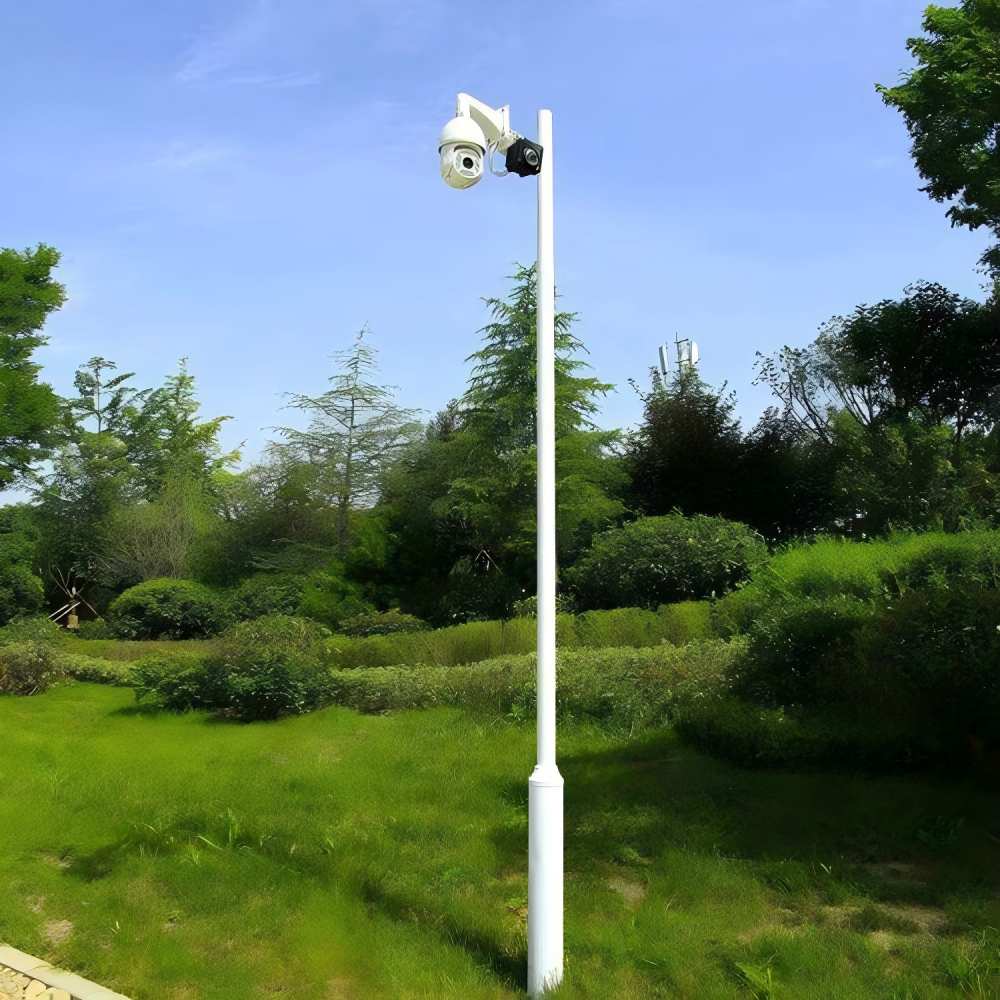
steel cctv pole

Square CCTV Camera Pole

4–10 m surveillance columns with concealed cableway and 1- to 4-way camera brackets on the flat faces.

steel traffic signal pole

Square Traffic Signal Pole

6–12 m signal columns and mast arms for signal heads, detectors and joint-use lighting brackets.

Steel Solar Lighting Pole 1

Square Solar Lighting Pole

5–12 m off-grid columns with panel frame and lockable battery box on the same flat-face shaft.

steel smart lighting pole

Square Smart Lighting Pole

8–14 m multifunction columns carrying lighting, cameras, sensors and signage on four mounting planes.
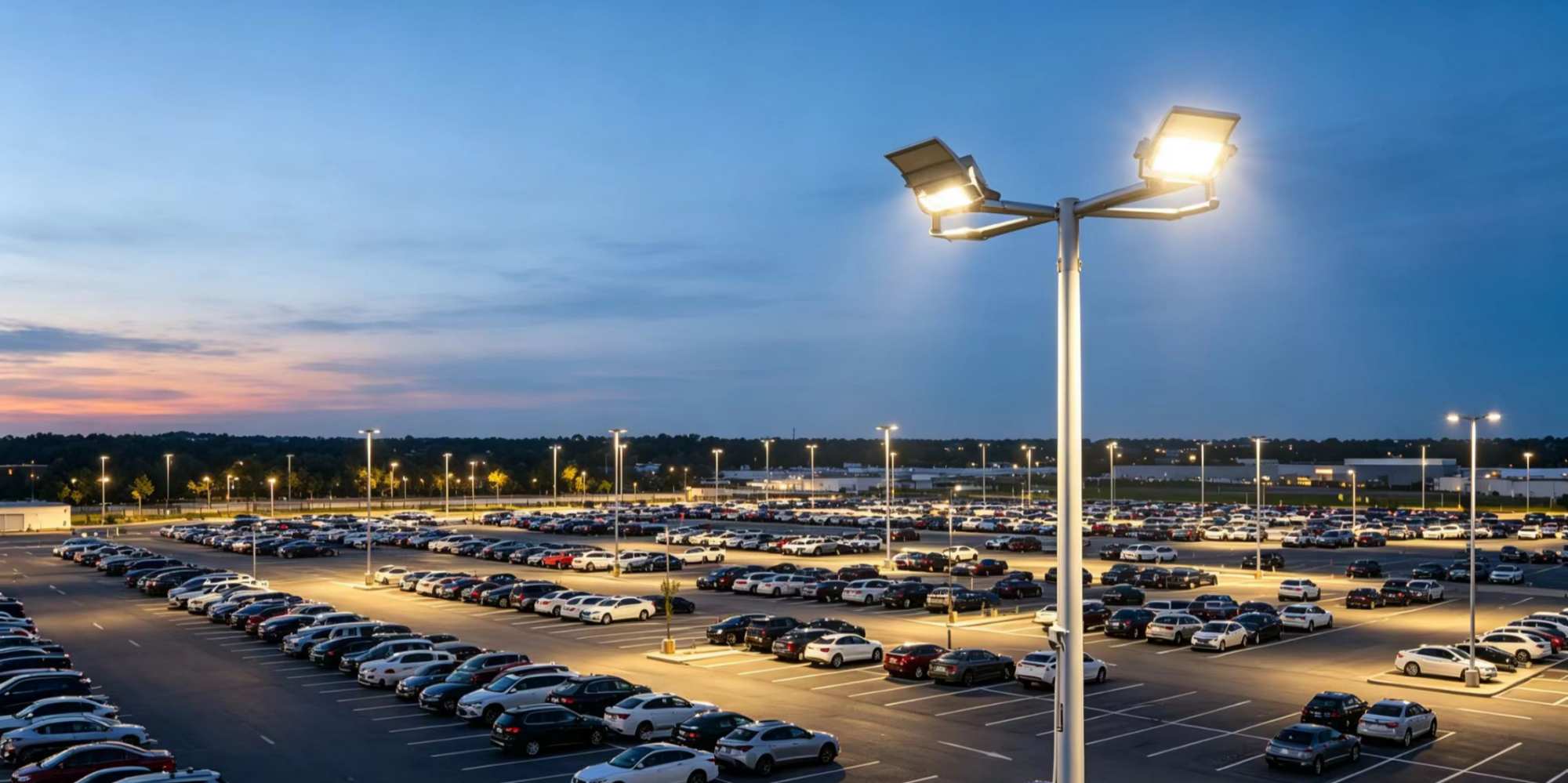
Where the brief is aesthetic — heritage streetscapes, park entrances, boulevards with a design code — the same shaft carries collars and lantern brackets as a decorative lighting pole or landscape lighting pole. Where height exceeds what a four-sided section does efficiently, compare an octagonal steel pole first.

Section Selection Guide
— Match Your Duty, Height And Wind Zone To A Square Shaft

Read the table left to right: the first four columns are conditions you already have, the last three our recommendation. These are standard ranges, re-verified on every order, because two poles of equal height can differ by 40% in base moment.

Application / duty Mounting height Fixture load & outreach Design wind Square shaft Wall Steel grade
Park path, landscape column 3–4.5 m 1 × 40–60 W, 0.6 m arm 33 m/s 100–120 mm 2.5–3.0 mm S275JR
Retail car park, 30–80 bays 6–8 m 2 × 100–150 W, 1.2 m arm 33 m/s 150–180 mm 3.0–4.0 mm S275JR
Urban arterial, double arm 9–10 m 2 × 150–240 W, 2.0 m arm 33 m/s 200–220 mm 4.0 mm S275JR
Industrial yard, floodlight frame 12–15 m 4 × 200–300 W, 1.5 m frame 35 m/s 250–300 mm 5.0–6.0 mm S355JR
CCTV cluster, 3 cameras 6–8 m 3 cameras + cabinet, 1.2 m 33 m/s 180–200 mm 3.0–4.0 mm S275JR
Traffic signal, 6 m mast arm 6–7 m Signal heads + detectors 33 m/s 200–250 mm 5.0 mm S355JR
Signage post, 2 m² panel 4–6 m Panel 1.5 × 1.3 m, offset 35 m/s 150–200 mm 4.0 mm S275JR

Indicative shaft schedule for square steel poles. Wind values are 10-minute mean at 10 m, per MS 1553 / EN 1991-1-4 practice. Shaft size is the side length, measured across flats, never across corners.

For a longer return period, coastal exposure or a cyclone region, widen the shaft one step before adding wall — face width buys more capacity per kilogram than thickness, provided c/t stays under the slender limit.
Two rules hold. A 20 mm increase in shaft width adds more modulus than 1 mm of extra wall, and costs less. Above 15 m, or with four fixtures or more on the head, the table stops applying.

Not sure which shaft fits? Send your load case and we will size it

Height, shaft, fixture load, wind speed, site. We return a section and a stamped calculation — no obligation.

Geometry, Steel Grade And Coating
— The Three Variables That Decide A Square Pole's Twelfth Year

Buyers compare square poles on height, shaft size and price, and those numbers say little about year twelve.
What governs is efficiency per kilogram, whether the wall suits the face, and whether zinc reached the inside of the tube.

What the four-sided geometry actually buys you

We ran the section properties at a common 200 mm envelope and 4.0 mm wall from exact geometry, not tables. Square is the most efficient profile per kilogram, and the only one whose capacity depends on wind direction.

Section Steel area (mm²) Mass (kg/m) Z, wind on face (×10³ mm³) Z, wind on corner (×10³ mm³) Z per kg
Square, 200 × 200 × 4 3,136 24.6 201 142 8.2
Octagonal, 200 across flats × 4 2,598 20.4 132 122 6.5
Round tube, 200 OD × 4 2,463 19.3 118 118 6.1
Round tube, 200 OD × 5.12 (equal mass) 3,135 24.6 149 149 6.1

Section comparison at a 200 mm envelope and 4.0 mm wall, from exact geometry of thin-walled hollow sections. Face and corner columns are the two wind orientations; round sections are identical in both.
First and last rows: at equal mass a square carries 35% more modulus than a round tube, but only with the wind on a face. The octagon uses 17% less steel for 34% less moment, so square wins wherever the shaft governs.

Why a stronger grade does not rescue a thin wall

We hold S235JR, S275JR and S355JR plate to BS EN 10025-2, plus Q235B and Q355B. S275 to S355 raises yield 29%, but ε = √(235/fy) falls from 0.924 to 0.813, so the class 3 face limit drops from about 39 to 34 — a 200 × 4 shaft slender in S275 becomes more so in S355. The answer is more wall or a narrower face: below 8 m, S275 on 150–180 mm; above 10 m with a floodlight array, S355 on 250–300 mm at 5–6 mm, where c/t is back under 40.

Hot-dip galvanizing to ISO 1461

Poles are degreased, pickled, fluxed, dipped at about 450 °C and inspected. ISO 1461 minima — 70 µm on 6 mm plate and thicker, 55 µm on 3–6 mm — give 25 years maintenance-free. A square is harder to coat than a round tube: zinc must flow down four faces, drain from four corners and reach a box that will not vent itself. So every square pole we build carries a vent at the top, a weep hole at the base and a door frame welded in, not cut in. Duplex — galvanizing plus polyester powder at 180–200 °C.

Square Poles In Service
— Car Parks, Streetscapes, Equipment Mounting And Industrial Yards

Four duty profiles cover about 80% of what we ship, each governed by a different load: fixture area on a short arm, wind on a long arm, bracket count on one shaft, or the speed of installing a hundred identical units.

Hinged Poles in Car Parks and Commercial Areas

Retail car parks and mixed-use podiums

Short poles, wide spacing, a hard cost target per bay. The governing case is usually the headframe, not the shaft: four floodlights on 1.5 m brackets at 12 m give a local moment a 3 mm wall will not take. Square is chosen because the frame bolts to a plane, so aiming fixtures is a two-spanner job.
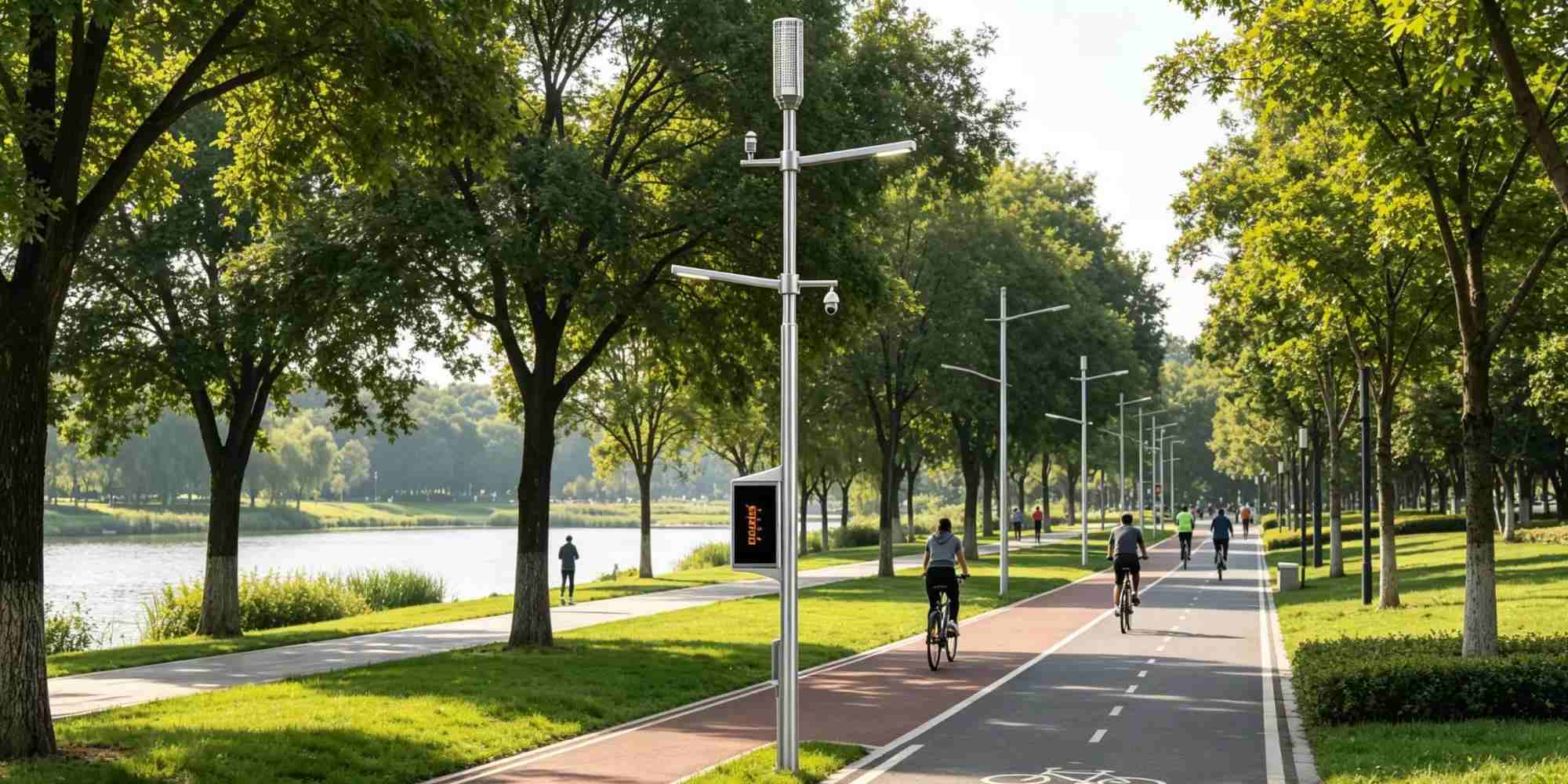
Headframe options are on the flood lighting pole page.

smart poles in public parks recreational trails

Streetscape and architectural corridors

Here the square is chosen as much for the elevation as the modulus: a four-sided column reads as part of the building where a round one reads as street furniture. The structural question is wind on a 2 m arm; the detailing one is joining a square shaft to a luminaire made for a round spigot.
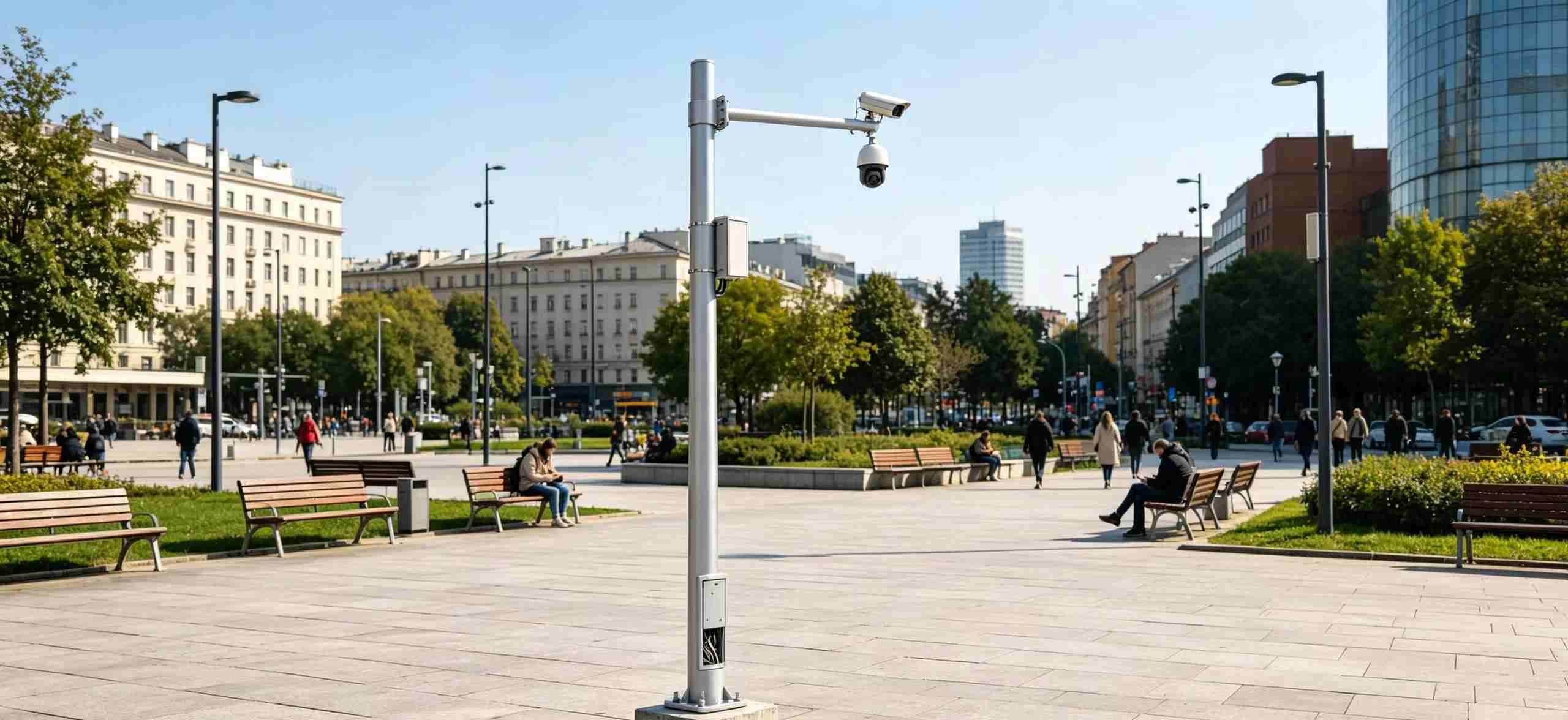
Decorative collars and lantern brackets are under decorative lighting pole.

CCTV camera poles for municipal public spaces

CCTV, signage and traffic equipment

The load is eccentric clutter, not wind: three cameras, a junction box and a display on their own brackets. Two things matter. Cable access — a 50 mm entry on each face and an internal plate, so nothing is surface-run. And torsional stiffness, where the closed square tube does well: a camera at 1.2 m outreach twists a 180 mm shaft far less than a round column, which keeps a zoomed image steady.
Bracket layouts are on the CCTV camera pole and traffic signal pole pages.

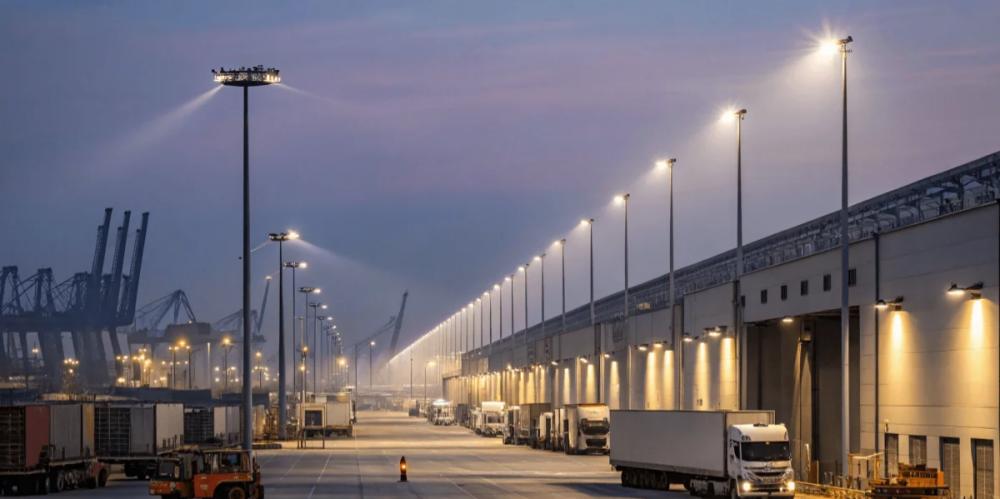
high light mast for industrial and logistics yards

Industrial yards, depots and logistics terminals

Volume work with a predictable load and one unpredictable driver: a yard pole gets hit. The response is not a thicker wall but a base that survives replacement — a square plate on four cast-in bolts, a zinc-rich patch on the impact zone, and a section re-orderable from the original drawing.

Off-grid configurations are under solar lighting pole.

Why Source Square Poles From Morelux Malaysia

We form, weld, galvanized and pack the poles inside the group that signs the drawing.
There is no intermediary to blame and the fix is decided in a factory, not a chain of emails.

choose Morelux as your steel poles manufacturer 1

Globally Recognized Standards Compliance

Our poles comply with AASHTO, AS/NZS, BS EN, MS, and SANS standards, ensuring safety, quality, and acceptance across international markets.

Verified Structural Design & Engineering

Certified pole design software is used to analyze wind loads, fixture loads, and structural performance for proven strength and stability.

Premium Steel for Reliable Performance

All steel materials comply with BS EN 10025 or approved equivalent standards, ensuring consistent quality and dependable structural integrity.

Certified Welding & Long-Term Corrosion Protection

Welding follows BS EN 1011-2 standards, while hot-dip galvanizing to ISO 1461 delivers superior corrosion resistance and service life.

Where we will tell you not to use a square pole

Above about 15 m a four-sided section stops paying: plate width and wind area grow faster than capacity, and an octagonal or round shaft is cheaper per kN·m. Above 50 m/s sustained, the corners that make a square stiff also make it a high-drag bluff body. Where a tender's brand list is closed, we say so at enquiry.

Procurement Guide
— Price Factors, Lead Time, MOQ And After-Sales For Square Poles

1. Shaft width and wall thickness

The largest driver. Every 1 mm of wall on a 9 m, 200 mm column is about 45 kg of steel and 6–8% of pole price; 20 mm more shaft adds 4–6% to cost and 15–20% to modulus.

2. Steel grade

S275 to S355 adds 8–12% to the material line, often allowing a thinner wall, so it comes out neutral — but only where c/t stays under 40.

3. Coating system

ISO 1461 galvanizing is the baseline; duplex adds 25–40%. A corrosion allowance of +1 mm for 30-year coastal life is usually cheaper than either.

4. Door, base and bracket detailing

A standard door with a welded frame is included. Double doors, anti-theft hinges, DIN rail and tenon adapters are small individually, 10–15% as a package.

5. Quantity, repeatability and delivery terms

Identical poles amortise drawing, programme and press set-up; mixed heights add time. FOB is cheapest; CIF and DDP add 5–18%.

Lead time, minimum order and spares

Standard poles ship in 20–40 days from drawing approval, coating inside that window rather than added to it; traffic structures with long mast arms take 30–45 days. Minimum order is flexible — we will produce one trial unit, because a sample pole is the cheapest way to verify a factory. Spare doors and anchor sets are held so a damaged door is not a 40-day outage.

After-sales Service and Warranty

Structural warranty is 5 years, coating 10 years, against defects in fabrication and galvanizing rather than site damage. The useful commitment is response: enquiries answered within 12 hours, and a challenged calculation re-run and reissued with the wind orientation stated.

steel poles manufacturer

Square Steel Pole FAQ
— Range, Wind Orientation, Replacement And Certificationn

Street lighting poles 4–12 m, car park and area lighting poles 6–15 m, CCTV camera poles 4–10 m, traffic signal poles 6–12 m, solar poles 5–12 m, and smart or compound poles 8–14 m. All six use the same four-sided section and galvanizing line.

At equal mass a square shaft carries about 35% more section modulus than a round tube, but only when the wind meets a face; at 45° it falls back to round-tube performance. Round poles cost less to form, carry no orientation risk and shed storm wind better.

Square shafts 100–300 mm as standard and 400 mm as a bespoke section; walls 2.5–12 mm; heights 4–45 m, with square sections above 15 m quoted only after comparison against an octagonal shaft. Grades are S235JR, S275JR and S355JR to BS EN 10025-2, plus Q235B and Q355B, each with an EN 10204 3.1 mill certificate.

With the wind on a corner. That is the governing case and it is 29% lower than the face-on value, because the extreme fibre sits at the diagonal. Lock the arm, door and any heavy bracket to the face the calculation assumed, or site crews will rotate the pole for convenience.

20 to 40 days from drawing approval, with galvanizing and duplex coating inside that window; mast-arm traffic structures take 30–45 days. Spare doors and anchor sets ship within 10 working days, and a single trial pole is produced in the same window, before any batch commitment.

Yes — OEM and ODM poles with the customer’s branding, drawing pack and packing marks, and we do not approach the end client. Doors, base plates, brackets, tenons and cable entries are built to your drawing with no tooling charge, because the section is formed from plate.

Calculated to BS EN 40-3-1, AASHTO LRFD and MS 1553 as applicable, welded to BS EN 1011-2, galvanized to ISO 1461, under an ISO 9001 system. To verify rather than accept, ask for four documents: the EN 10204 3.1 mill certificate with heat number, the galvanizing report tied to your batch, the WPS/WPQR, and the calculation naming standard, wind speed and orientation.

Statement of openness:

The drag coefficient is a standard value for a sharp-edged bluff section, not a wind-tunnel measurement of our pole, and a site in complex terrain should use project-specific values. Company figures — plant area, export count, lead time, salt-spray hours — come from our own records and are not independently audited; the catalogue and plant photographs are the evidence we can offer. We do not claim certification by a body that has not certified us, and we do not claim brand pre-approval on any tender list. Where we are not the right supplier — a height beyond 15 m where an octagonal shaft is cheaper, a cyclone exposure, a closed brand list — we say so before quoting.

contact MORELUX

If you have any questions, would like a quote for custom steel poles, or need our advice in a specific area, please feel free to contact us. We will reply to you within 12 hours.