

A telecom monopole is a single, thin vertical pole. It holds antennas and wireless gear. You see these poles everywhere—along highways, in neighborhoods, on rooftops. Yet most people don’t know their name. The pole’s main features are a small base and steel build. City planners like this design for tight spaces. Roads and highways benefit from its small ground area. These poles are usually under 200 feet tall. They install quickly, which fits modern network needs. Monopoles blend into the area better than lattice towers. They take up less land than guyed structures. This efficiency makes them a top choice for new projects. Read on to find out why this engineering solution is so common today.
Key Takeaways
- Telecom monopoles are thin steel poles that support antennas and wireless equipment, fitting into small spaces like sidewalks and parking lots.
- Their small size saves space and money, making them perfect for cities and suburbs.
- Monopoles go up fast because they come ready-made, cutting building time down to just days.
- Engineers build them to handle heavy winds and meet tough safety rules for strength and lasting use.
What Is a Telecommunications Monopole? Definition and Purpose
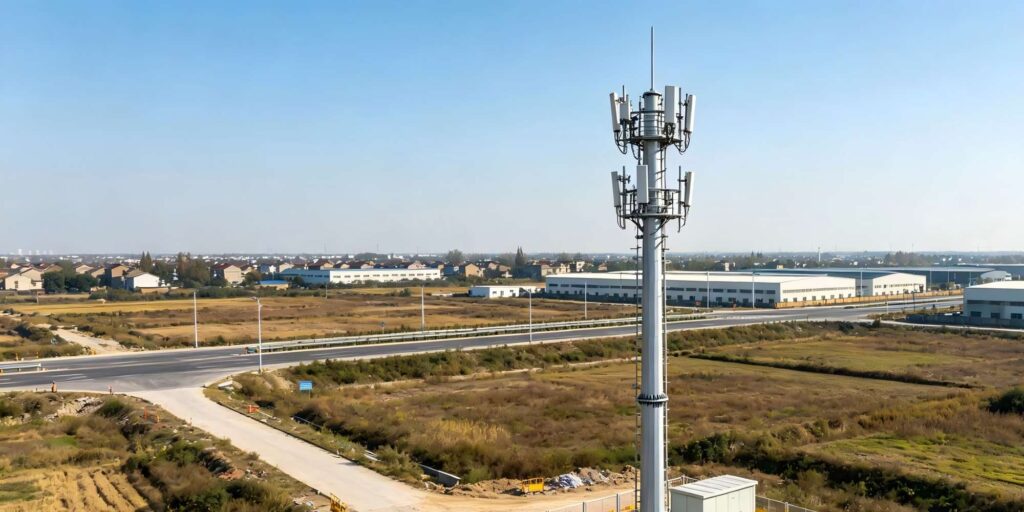
A telecommunications monopole is a freestanding structure with a single steel shaft designed to support antennas, remote radio heads, and other wireless communication equipment. Its tapered, tubular design provides structural strength while requiring less space than many lattice or guyed tower configurations.
Telecommunication monopoles are commonly designed in different heights according to coverage requirements, equipment loads, wind conditions, and site limitations. MORELUX provides standard telecom monopoles from 15 m to 45 m, with customized designs available for specific projects.
The main purpose of a telecom monopole is to elevate communication equipment above buildings, trees, and other obstacles, helping improve wireless signal coverage. The compact structure also makes it suitable for urban and suburban sites where available land is limited.
Steel is widely used because of its strength and durability. MORELUX telecom monopoles can use structural steel such as S275JR and S355JR. For outdoor applications, a galvanized steel pole provides corrosion protection, while a powder coated steel pole offers additional surface protection and color options.
Key Features of a Telecommunications Monopole
- Single tubular steel shaft with a compact footprint
- Supports antennas, RRUs, microwave equipment, and other telecom systems
- Standard heights from 15 m to 45 m, with custom heights available
- Slip-joint or flanged structural configurations
- Custom antenna frames, equipment platforms, and mounting brackets
- Hot-dip galvanizing and other protective coating options
- Designed according to project-specific loads and applicable standards
Overall, a telecommunications monopole provides a practical solution for modern wireless infrastructure, combining efficient land use, structural performance, and flexible equipment configurations.
Where Are Telecom Monopoles Commonly Used in Networks?
Telecom monopoles are widely used in urban and suburban wireless networks where reliable coverage and efficient land use are important. Their compact steel structure fits well into locations such as parking areas, roadsides, public spaces, and other sites with limited space.
Urban Cellular Network Deployment with Telecom Monopoles
In urban areas, buildings and dense development can create coverage gaps. Telecom monopoles provide a compact way to elevate antennas without requiring a large tower site.
Common locations include:
- Residential and commercial areas
- Parking lots and roadside sites
- Parks and municipal properties
- Urban redevelopment zones
- Highway and traffic corridors
Their small footprint helps network operators install communication equipment while minimizing disruption to pedestrians, traffic, and surrounding properties.
4G and 5G Network Expansion Using Telecom Monopole Towers
The expansion of 4G and 5G networks requires additional sites to improve coverage and network capacity. Telecom monopole towers can support antennas, small-cell equipment, RRUs, and other wireless infrastructure at locations where larger towers are impractical.
For 5G deployment, compact monopoles can be positioned closer to users to address localized coverage and capacity requirements. Their streamlined design also makes them suitable for urban areas where infrastructure must have a limited visual and physical impact.
In smart city projects, a telecom monopole can potentially support communication equipment alongside lighting, sensors, and other infrastructure, helping make better use of limited public space.
Key Advantages of Steel Telecom Monopole Structures
Space-Efficient Design of Telecom Monopole Towers
The main advantage of a steel telecom monopole is its compact footprint. A typical installation can require only 9 to 18 square meters of ground space, making it suitable for sites where land is limited.
Compared with guyed towers, monopoles require less surrounding space because they do not need anchor cables. This simplifies site planning and can reduce land, foundation, and civil work requirements. The compact design makes telecom monopole towers practical for parking lots, roadside locations, narrow medians, and other urban sites.
Faster Installation with Prefabricated Telecom Monopole Poles
Prefabricated telecom monopole poles are manufactured before delivery, including steel cutting, forming, welding, and surface treatment. This reduces the amount of fabrication required on site and helps simplify installation.
MORELUX manufactures telecom monopoles in-house, allowing production and quality control to be managed before shipment. Depending on the design, slip-joint or flanged connections can also be used to suit different installation requirements.
Low Visual Impact of Steel Telecom Monopoles in Urban Areas
The slim profile of a steel telecom monopole creates less visual impact than larger lattice or guyed towers. This makes it suitable for urban areas, residential communities, parks, and other locations where appearance is important.
MORELUX offers camouflage options, including fibreglass shrouds and tree-style structures, to help the monopole blend into its surroundings. Hot-dip galvanizing, powder coating, duplex coating, and custom RAL colors are also available for different environmental and aesthetic requirements.
Engineering Considerations for Telecom Monopole Design
Telecom monopole design must account for structural loads, environmental conditions, antenna equipment, and site requirements. Engineers use these factors to determine the pole dimensions, steel thickness, connections, and foundation design.
Structural Loads and Wind Design for Telecom Monopole Poles
Wind loads are a key consideration for steel telecom monopole poles. Engineers evaluate wind pressure on both the pole and mounted equipment, including antennas and other communication components.
Standards such as ANSI/TIA-222-H provide structural design requirements for telecommunications support structures. Project-specific calculations consider factors such as wind, ice, equipment loads, pole height, and site conditions to verify structural performance.
MORELUX can provide structural calculations and wind load analysis for custom telecom monopole designs, helping ensure the pole meets the required project specifications.
Foundation Requirements for Steel Telecom Monopole Structures
The foundation transfers loads from the steel telecom monopole into the ground and must resist vertical, lateral, and overturning forces. Foundation requirements therefore depend on the pole design as well as local soil and site conditions.
MORELUX offers foundation solutions including anchor-bolt foundations, direct embedment, and reinforced concrete bases. The appropriate design can be determined based on pole height, wind loads, seismic conditions, soil properties, and equipment loading.
Coordinating the monopole and foundation designs early helps ensure structural stability and simplifies installation.
Manufacturing Quality Standards for Steel Telecom Monopoles
Telecom monopoles must meet strict quality and structural requirements to ensure safe and reliable operation. MORELUX applies quality control throughout material selection, fabrication, welding, surface treatment, and final inspection.
Key standards may include:
| Standard | Application |
|---|---|
| ISO 9001 | Quality management system |
| TIA-222-H | Telecom tower structural design |
| ASTM A36 / A572 / A595 | Steel material requirements |
| AWS D1.1 | Structural welding requirements |
| AISC | Steel structure design and construction |
Steel grades are selected according to factors such as pole height, wind loads, and equipment weight. Welding quality is also controlled through procedures and inspections to maintain structural integrity.
For corrosion protection, hot-dip galvanizing can be applied according to relevant galvanizing standards. Powder coating or other finishes may also be added when specific environmental or appearance requirements apply.
Production records, material certificates, welding inspections, and coating tests provide traceability throughout manufacturing. This quality-control process helps ensure that each steel telecom monopole meets the required project specifications and performance standards.
Our Steel Telecom Monopole Customization Options
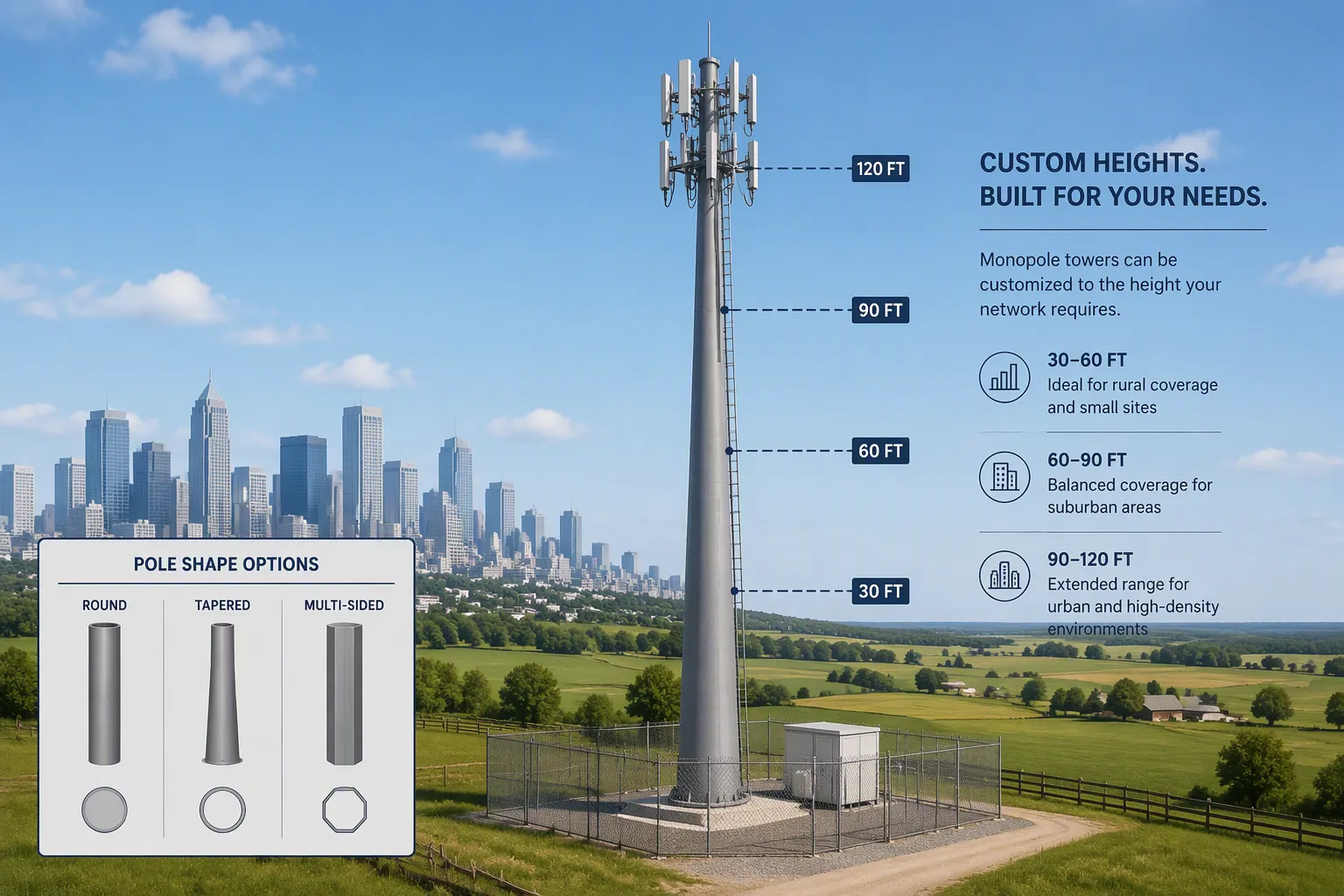
Every network project has different structural, environmental, and installation requirements. MORELUX provides customized steel telecom monopole solutions covering dimensions, materials, foundations, and protective finishes.
Custom Heights and Structural Designs for Different Network Needs
The required height of a telecom monopole tower depends on antenna elevation, coverage requirements, wind conditions, equipment loading, and local regulations. MORELUX standard telecom monopoles are available from 15 m to 45 m, with taller structures available through custom engineering.
MORELUX can also provide slip-joint or flanged structures for different installation requirements. Antenna mounting systems, equipment platforms, cable ladders, lightning protection, and climbing safety systems can also be configured according to the project.
Custom Steel Grades and Wall Thickness for Telecom Monopoles
Material selection and wall thickness are designed according to pole height, wind loading, antenna configuration, and equipment weight. MORELUX uses structural steel such as S275JR and S355JR or equivalent materials based on project specifications.
The telecom monopole can be engineered according to standards such as TIA-222 and EN 1993 (Eurocode 3). Structural calculations and load analysis help determine the appropriate steel grade, wall thickness, and section dimensions for each application.
Custom Foundation and Anchor Bolt Designs for Site Conditions
A suitable telecom monopole foundation must match the structural loads and ground conditions. MORELUX provides foundation solutions including anchor-bolt foundations, direct embedment, and reinforced concrete bases.
Foundation requirements can be developed according to soil conditions, pole height, wind loads, seismic requirements, and equipment loading. MORELUX can also provide structural calculations, foundation recommendations, and CAD drawings to support project coordination.
Hot-Dip Galvanizing and Coating Options for Telecom Monopoles
Telecom monopoles require effective surface protection for long-term outdoor use. MORELUX offers hot-dip galvanizing, powder coating, and duplex coating systems according to environmental and appearance requirements.
Hot-dip galvanizing provides corrosion protection for steel surfaces, while powder coating offers additional protection and custom RAL colors. For demanding environments, a duplex system combines galvanizing with an additional coating layer.
Telecommunications Monopole FAQ for Network Infrastructure Projects
What Are the Main Advantages of a Steel Telecom Monopole?
A steel telecom monopole provides a compact and structurally efficient solution for supporting antennas and wireless communication equipment. Its single-pole design requires less ground space than many lattice structures, making it suitable for locations where land availability is limited.
Steel construction also provides the structural strength required for antennas, microwave equipment, RRUs, and other telecom equipment. For outdoor network infrastructure, the pole can be protected with hot-dip galvanizing and other finishing options according to the project environment.
Where Are Steel Telecom Monopoles Commonly Used Today?
Steel telecom monopoles are commonly used for 4G and 5G network infrastructure, cellular communication sites, wireless communication networks, and other telecommunications installations. They are particularly suitable for urban and commercial locations where a compact structure and relatively low visual impact are important.
Depending on the project configuration, a telecom monopole can support sector antennas, microwave dishes, RRUs, cable systems, and other communication equipment required for network deployment and expansion.
How High Can a Telecom Monopole Tower Be Designed?
The height of a telecom monopole tower depends on factors such as required antenna elevation, wind conditions, equipment loading, site limitations, and applicable design standards. MORELUX standard telecom monopoles are available from 15 m to 45 m, while custom designs can be developed for projects requiring different heights.
The final height should be determined through structural analysis and site-specific requirements rather than by height alone. Wind speed, antenna loading, equipment weight, seismic conditions, and potential future expansion should all be considered during the design process.
Can a Steel Telecom Monopole Support Multiple Antenna Carriers?
Yes. A steel telecom monopole can be designed to support multiple antenna carriers when the required equipment configuration and structural loads are established during the engineering stage.
Multi-carrier configurations can accommodate multiple antenna sets, microwave equipment, RRUs, and other telecommunications equipment. Antenna frames, mounting brackets, and equipment platforms can be arranged according to the number and type of carriers, available space, and required loading capacity.
Can MORELUX Customize Telecom Monopoles for Specific Projects?
Yes. MORELUX provides customized telecom monopole solutions based on project-specific structural, environmental, and installation requirements. Customization can cover pole height, structural configuration, antenna mounting systems, equipment platforms, cable ladders, lighting, lightning protection, and climbing safety systems.
For different site conditions, MORELUX can also customize foundation solutions and protective finishes. Structural designs can be developed according to project requirements, including wind speed, seismic conditions, antenna loads, equipment weight, and applicable standards.