

A lighting pole exists to light public places at night. This simple job keeps streets safe, easy to see, and useful after dark. The need is urgent. About 76 percent of pedestrian deaths happen at night. The nighttime death rate on U.S. roads is three times the daytime rate.
Yet a lighting pole does much more than just light a road. It helps with safety, helps people find their way, brings people together, and affects how a neighborhood looks. This post goes through each purpose with real examples, from crosswalks to parking lots.
Key Takeaways
- Light poles make streets safer when it is dark. They help drivers see people walking and avoid crashes.
- The right height and spacing of light poles give even lighting. This cuts down dark spots and glare.
- Places with good lighting make people feel safer and help stop crime. They also get people to go outside at night.
- Light poles are built to stand up to wind and hold lights. They can also hold cameras and traffic signals.
- Custom light poles are made to fit many needs, from highways to parks. They come in different shapes and finishes.
What Is the Main Purpose of a Light Pole in Outdoor Lighting?

A light pole is a structural support that positions a lighting fixture at the required height and location. Its main purpose is to provide effective illumination while supporting the fixture under outdoor conditions. The pole height, configuration, and mounting arrangement are selected according to the lighting application and project requirements.
Elevating Lighting Fixtures for Wider and More Effective Coverage
Raising the luminaire allows light to reach a larger area and helps create more uniform illumination. The required mounting height depends on factors such as road classification, coverage area, fixture type, and lighting requirements. For example, MORELUX lists 4.5–6 m for neighborhood streets and 7.5–15 m for arterial roads and expressways.
Light pole spacing also works together with mounting height to control coverage and uniformity. The pole and luminaire therefore need to be considered as one lighting system rather than separately.
Improving Visibility and Safety in Outdoor Public Areas
Street lighting poles help place luminaires where they can provide consistent illumination for vehicles and pedestrians. In public areas, suitable pole height and positioning can reduce poorly lit sections and improve visibility along roads, walkways, intersections, and other outdoor spaces.
MORELUX supplies street lighting poles for residential streets, city roads, highways, parks, and other outdoor applications. Different pole heights and configurations allow the lighting system to be matched to the specific environment.
Directing Light to Roads, Pathways, and Specific Target Areas
A light pole also determines where a luminaire is positioned and, therefore, where its light can be directed. Single-arm, double-arm, curved, and other mounting configurations can be selected for different road layouts and target areas.
For example, roadway projects may use tapered or octagonal steel lighting poles with single- or double-arm configurations, while parks and pathways may require different heights and arrangements. Selecting the appropriate pole structure helps position the lighting fixture according to the required coverage area.
How Do Light Poles Help with Different Outdoor Lighting?
A light pole makes dark roads, paths, and parking lots easier to use. Each use needs a different pole type, height, and spacing. The goal stays the same: even light all along the path.
Street Light Poles for Roads, Streets, and Urban Traffic Areas
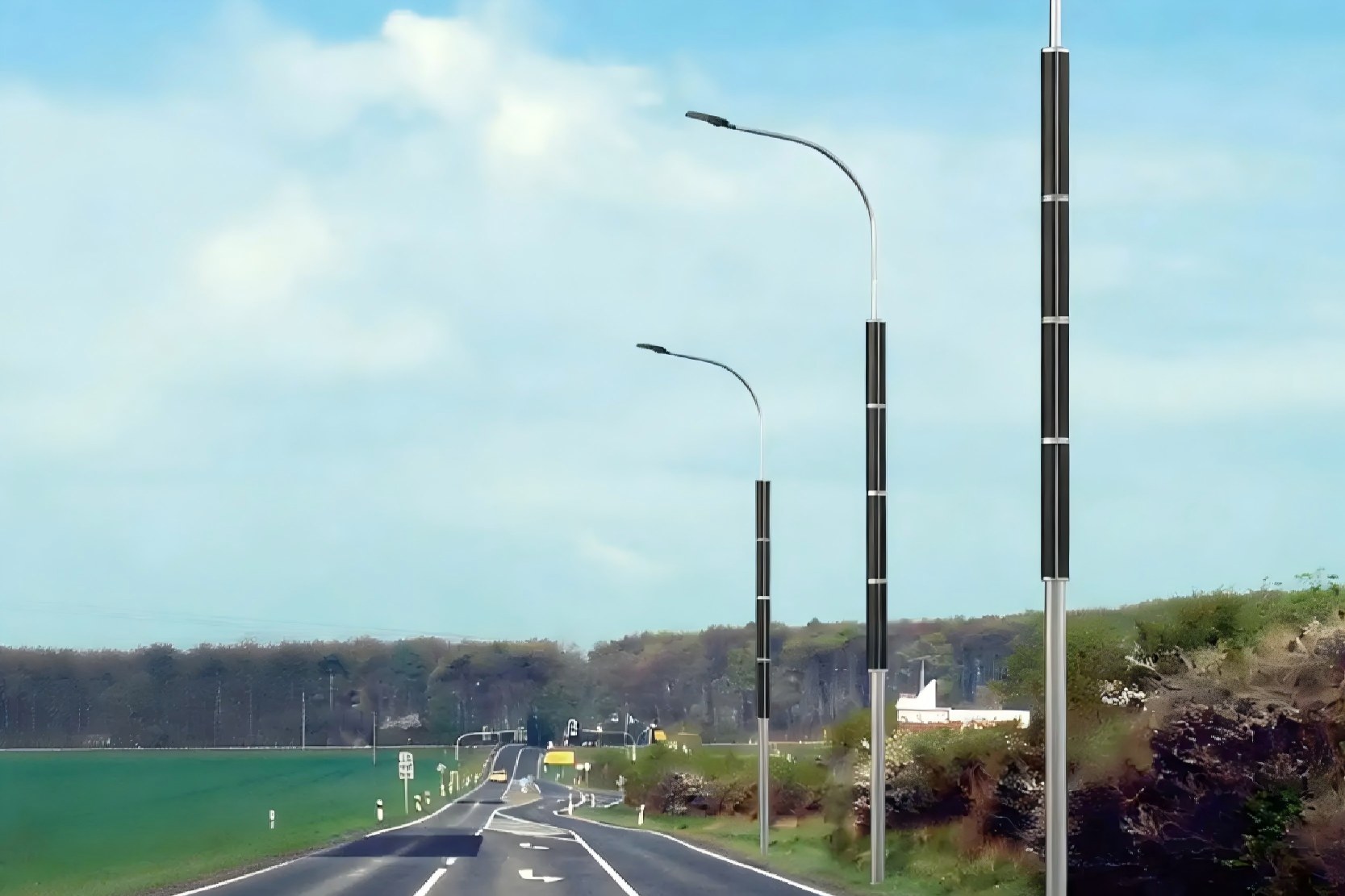
Street light poles are designed to provide consistent illumination along roads and traffic areas. Pole height and spacing are selected according to road width, traffic conditions, lighting requirements, and luminaire performance.
MORELUX provides road and street lighting poles in different heights and configurations. Main roads can use 8–15 m conical or hexagonal steel poles, while highway applications may require 12–20 m or higher octagonal and high mast poles. Single- and double-arm configurations can also be used for different road layouts.
Parking Lot Light Poles for Safer Vehicle and Pedestrian Movement
Parking lot lighting needs to cover both vehicle areas and pedestrian routes without leaving poorly illuminated sections. Pole height, mounting position, and fixture arrangement should therefore be selected according to the size and layout of the parking area.
MORELUX supplies steel poles for parking lots, with customized heights, arm configurations, and mounting options. These solutions can support area lighting for shopping centers, offices, hospitals, schools, and transportation hubs.
Area Light Poles for Parks, Campuses, and Public Open Spaces
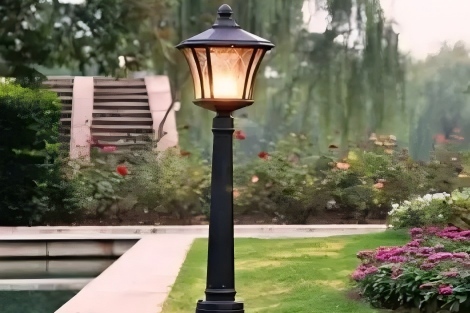
Area light poles are used where lighting needs to cover open spaces rather than a single roadway. Parks, pathways, campuses, plazas, and other public areas may require lower mounting heights and different fixture arrangements to suit pedestrian-scale environments.
MORELUX lists 3–6 m steel poles for gardens and parks, while its technical guidance gives 3–4.5 m as a typical range for parks and footpaths. Round and decorative steel poles can also be customized for landscape and public-space applications.
High Mast Light Poles for Large-Scale Outdoor Lighting Coverage
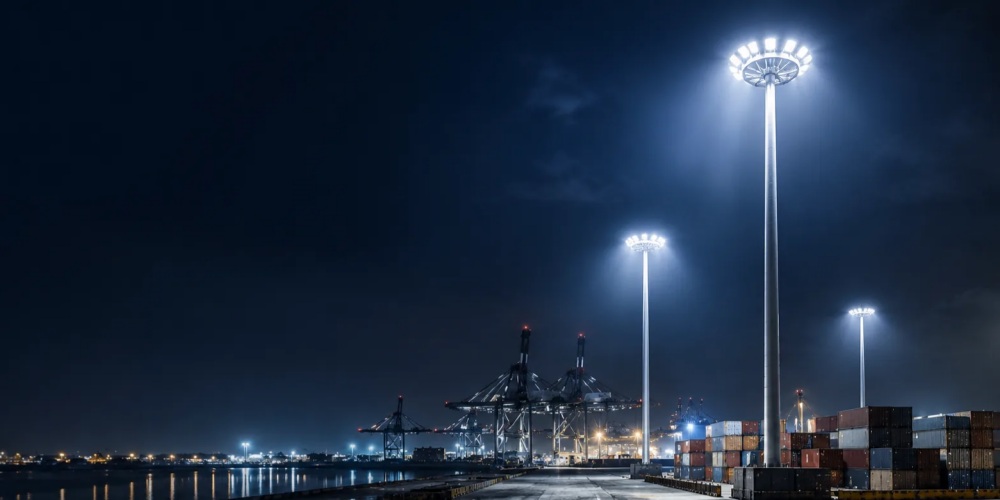
High mast light poles are designed for large areas where a smaller number of tall lighting structures can provide wide coverage. They are used for highways, airports, ports, logistics centers, stadiums, and other large outdoor facilities.
MORELUX manufactures high mast poles from 12–45 m, with options including fixed mast, hinged mast, and raising-and-lowering systems. Height, wall thickness, wind-load capacity, lifting systems, and luminaire arrangements can be customized according to project requirements.
Why Does Light Pole Height Matter for Outdoor Lighting Performance?
Height decides how well light spreads across a space. A lighting pole that is too short makes bright circles under the fixture and darkness everywhere else. A pole that is too tall wastes light and adds pollution. The right height balances coverage, evenness, and comfort.
Balancing Mounting Height With Lighting Coverage and Uniformity
Uniformity measures how even light levels are from one point to another. A common goal is a 4:1 ratio, where the brightest spot is no more than four times brighter than the darkest. The general rule for pole spacing is 2.5 to 3 times the mounting height. For a 25-foot mount, spacing of 62.5 to 75 feet is typical to achieve uniform illumination.
Wider sites need taller poles so light reaches farther between rows. Poles near homes should be shorter or use shielded fixtures to cut light spill. Taller poles also face greater wind loading, which may require larger bases. Local codes may impose limits on commercial pole heights.
Positioning Light Fixtures to Reduce Dark Spots and Glare
Fixtures mounted too low sit near a driver’s line of sight. That position creates harsh brightness and makes pedestrians, parking stripes, and curbs harder to see. Taller mounting places the light source higher, which reduces glare and improves visual contrast. Short poles also cast longer, sharper shadows behind vehicles and landscaping. Those shadows hide obstacles. Taller poles soften them so details stay visible.
Aiming matters as much as height. Fixtures aimed incorrectly or spaced too far apart produce dark areas. Proper orientation directs light where it is needed and prevents trespass beyond the boundary. Proper mounting height and aiming help minimize glare and shadows, as recommended by engineering guidelines.
These choices shape daily life after dark. Well-lit spaces let people gather, exercise, and socialize. Evening walks, community events, night markets, and sports practice all depend on steady light. Street light poles give residents, workers, and travelers a sense of safety and security.
Selecting Pole Height Based on Site Layout and Lighting Requirements
Pole height should be selected according to the road or site layout, required coverage, luminaire specifications, and local conditions. MORELUX considers factors such as pole height, luminaire weight, wind load, and Effective Projected Area during engineering design.
MORELUX offers steel lighting poles from 4 m to 45 m across different applications. Standard street lighting poles are available from 4 m to 12 m, while larger high-mast structures can reach greater heights when wide-area coverage is required.
What Role Does Light Pole Design Play in Lighting Applications?

Design affects how a light pole works and looks. A good design makes a street look better. Decorative and landscape poles look good and work well. They light a path and make the area nicer. Poles also hold other things besides lights. Traffic signals, cameras, and telecom gear often share the same pole.
Supporting Lighting Fixtures Under Different Wind and Load Conditions
Wind pushes against every pole. The structure must resist that force for many years. Several design features decide how well a pole handles wind and load.
| Design Factor | Effect on Wind Resistance |
|---|---|
| Pole height | Taller poles have to resist more bending force |
| Pole shape | Round, eight-sided, and square shapes move through air differently |
| Shaft diameter and wall thickness | Larger, thicker parts make the pole stiffer |
| Base connection | The weld at the bottom and the bolts hold the pole down |
| Corrosion protection | Galvanizing and coating protect the pole from rust over time |
Engineers check pole strength with a steady force test, watching for bending or lasting damage. Standards provide guidelines for steel pole construction. Wind load calculations are based on local wind speeds.
Matching Pole Configuration With Fixture Size and Mounting Needs
The effective projected area (EPA) of a luminaire is used to calculate wind load. Engineers sum the EPA of all fixtures and brackets to determine total load. Banners, signs, and extra brackets add to this total and must be counted.
The bracket you pick depends on the light and pole. Bracket types vary, including options for single or multiple arms. Manufacturers offer poles in various shapes and finishes to suit different applications.
Choosing Durable Pole Materials for Long-Term Outdoor Applications
Material and surface treatment directly affect how a steel lighting pole performs outdoors. MORELUX uses steel materials conforming to BS EN 10025 or approved equivalents and provides hot-dip galvanizing according to ISO 1461.
For additional protection or appearance requirements, powder coating and duplex coating systems are also available. These options allow the pole finish to be selected according to the project’s environmental and performance requirements.
Our Light Pole Solutions for Different Outdoor Lighting Projects
Custom Steel Light Poles for Different Project Requirements
Every project has different requirements for height, shape, mounting, and load. MORELUX provides custom steel light poles for roads, parks, stadiums, parking areas, and other applications.
Solutions include street lighting poles, solar lighting poles, flood lighting poles, high mast lighting poles, stadium lighting poles, CCTV poles, traffic signal poles, telecom monopoles, and smart lighting poles. Options include square, tapered, round, tubular, octagonal, and hexagonal designs, with single- or double-arm configurations.
Customization covers dimensions, mounting arrangements, surface finishes, and other project requirements.
Engineering Support for Light Pole Design and Structural Loads
MORELUX provides design drawings, structural calculations, wind load analysis, and technical recommendations for light pole projects.
Engineering considers pole height, luminaire weight, Effective Projected Area (EPA), and mounted equipment. MORELUX uses professional engineering software and follows AASHTO, AS/NZS, BS EN, and MS standards.
Quality control covers raw materials, welding, dimensions, galvanizing, and final inspection.
Corrosion Protection With Galvanized and Powder Coated Steel
MORELUX offers hot-dip galvanized, powder coated, painted, and duplex coating options for steel light poles.
Hot-dip galvanizing provides a protective zinc layer, while powder coating adds an additional finish and color options. Duplex coating combines both for additional corrosion protection.
These finishes can be selected according to the project’s environment, durability requirements, and appearance.
FAQs About the Purpose and Applications of Light Poles
What Is the Primary Purpose of a Light Pole in Outdoor Areas?
A light pole supports and elevates lighting fixtures so they can illuminate roads, paths, parking areas, and other outdoor spaces. Its height and configuration help position the luminaire according to the required lighting coverage and site conditions. MORELUX provides steel lighting poles in different structures for various outdoor applications.
Why Are Light Poles Important for Roads and Public Spaces?
Light poles provide the mounting structure needed for consistent outdoor illumination. On roads, they help position fixtures for traffic visibility, while in parks, pathways, and public areas they support lighting at suitable mounting heights. MORELUX supplies street lighting poles for residential streets, city roads, highways, parks, and other public applications.
How Does Light Pole Height Affect Outdoor Lighting Coverage?
Pole height affects the area that a lighting fixture can cover. Taller poles generally provide wider coverage, while shorter poles may require closer spacing to maintain uniform illumination. MORELUX recommends selecting height according to factors such as road classification, site layout, fixture specifications, and required lighting performance.
What Types of Projects Commonly Require Light Poles?
Light poles are commonly used for residential streets, urban roads, highways, parking lots, parks, footpaths, sports fields, stadiums, and other large outdoor areas. Different projects can use street lighting poles, solar lighting poles, flood lighting poles, high mast lighting poles, and other specialized steel pole solutions depending on their lighting requirements.