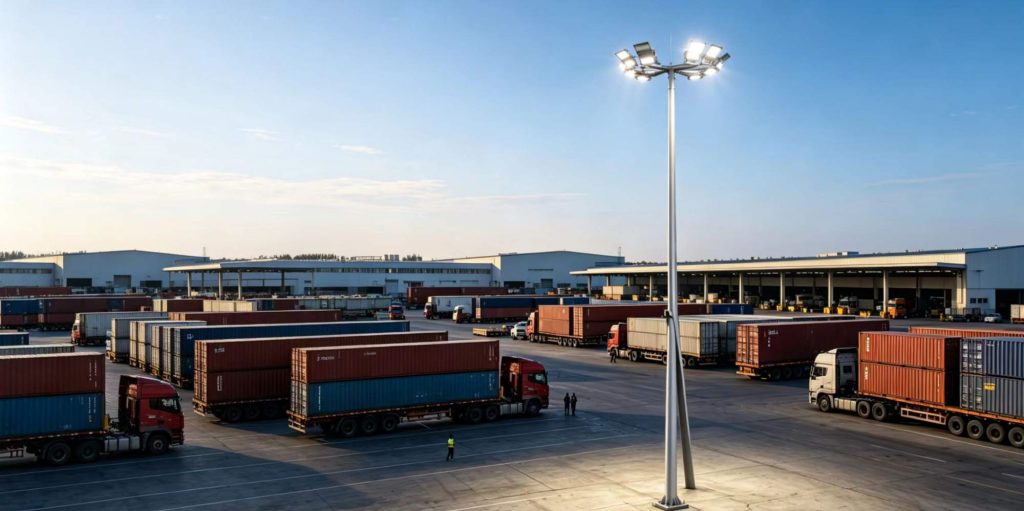
The best mounting option for a lighting pole depends on three things: field size, desired coverage, and budget. There are four main choices: pole-mounted, crossarm, high-mast, and building-mounted. Each one works for different sports. Pole-mounted setups are good for small courts. Crossarms work well for fields with many lights. High-mast systems serve large stadiums. Building-mounted options save ground space.
This post compares these options. It also explains how pole height, beam angle, wind load, and maintenance access affect the final choice. A 40-foot pole with the wrong bracket can cause glare. A 100-foot mast with bad maintenance planning becomes a safety risk. Understanding these trade-offs helps buyers and specifiers choose a setup that works reliably for years.
Key Takeaways
- Pick mounting options based on the size of the field, how much light you need, and your budget.
- Pole-mounted lights are great for small courts and let you aim them easily.
- Crossarms support multiple lights on one pole for even coverage.
- High-mast systems work well for big stadiums that use fewer poles.
- Check wind load and maintenance access before finalizing your mount.
Why Mounting Options Matter for Industrial Sports Lighting Poles
Mounting hardware decides how light lands on the field. A good bracket spreads light evenly across the playing surface. A bad match creates hot spots, dark corners, and blind spots. Players and officials cannot see through these. The uniformity ratio measures this evenness. It compares the brightest point on the field to the darkest. A 2:1 ratio means the brightest spot is twice as bright as the darkest. Lower numbers mean better light spread. Most high‑performing sports lighting systems land between 1.5:1 and 2.5:1. The ratio depends on the sport and competition level. Class I facilities need the tightest uniformity.
Wrong brackets or the wrong mount type cause real problems. A light aimed too low throws glare into players’ eyes. A light aimed too high wastes light into the night sky. Uneven coverage happens when lights sit at the wrong spacing or angle on the pole. These faults rarely show up on a photometric plan. They appear once the system is live and athletes start complaining.
Wind load analysis and structural ratings must come before any mount is final. Every fixture adds surface area to the pole. That area catches wind. According to ASCE 7‑22, velocity pressure rises with the square of wind speed. A jump from 110 mph to 150 mph increases the physical force on the pole and its fixtures by 86.0%. At 50 feet, the velocity pressure exposure coefficient is much higher than at ground level. So the bending moment at the base grows fast. A lighting pole above 100 feet in a moderate‑to‑high wind zone often needs vibration damping. This prevents fatigue failure. Galvanized steel remains the standard for sports lighting poles in over 90% of US installations. Check the pole’s rated capacity against the total fixture load before buying.
Common Mounting Options for Industrial Sports Lighting Poles
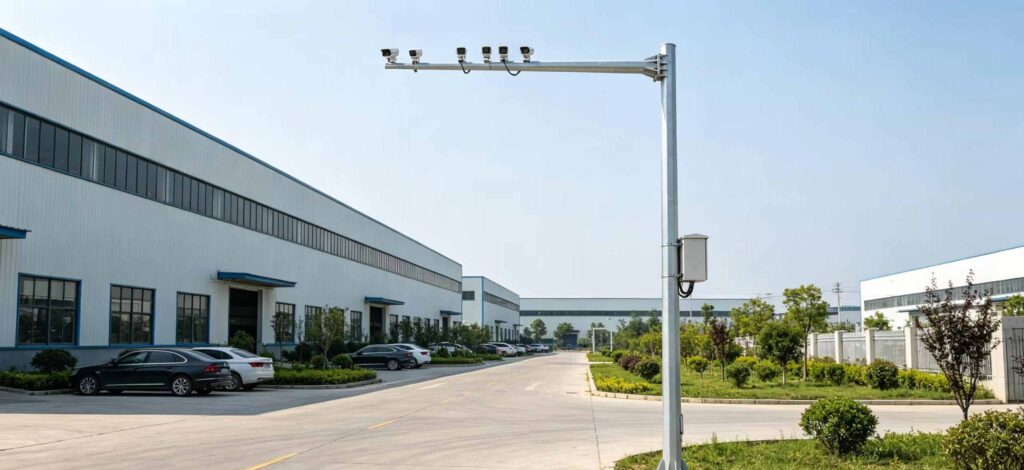
Pole-mounted lights are the most common choice for outdoor sports fields. Designers can fully control the height, placement, and aim of the lights. Typical poles are 40 to 100 feet tall. Each pole holds 1 to 12 lights, depending on the sport and needed light levels. A tennis court may need only two lights per pole. A football field often needs six or more lights per pole to meet Class I standards. Morelux makes steel poles built for these loads. The company provides calculations and wind load analysis to match the pole to the light count and local wind zone. This support prevents failures before installation starts.
Slip Fitter Mounts for Flexible Sports Lighting Pole Installation
Slip fitter mounts are widely used for sports lighting fixtures. The fixture slides onto a tenon and can be adjusted for vertical tilt and horizontal aiming. This makes slip fitters suitable for fields where lighting angles may need adjustment during installation or commissioning.
The tenon size must match the fixture bracket to ensure a secure connection. Slip fitter assemblies can be adapted to square, round, and octagonal sports lighting poles. MORELUX provides customized brackets and mounting solutions based on pole design, fixture requirements, and project conditions.
Trunnion and Yoke Mounts for Precise Sports Lighting Aiming
Trunnion and yoke mounts provide precise control over sports lighting fixture aiming. Their pivoting designs allow installers to adjust the beam direction accurately, making them suitable for applications where light distribution and glare control are important.
These mounts can support different fixture configurations according to project requirements. MORELUX can customize top plates and mounting structures based on fixture weight, wind load, pole design, and required lighting layout.
Adjustable Brackets for Flexible Sports Lighting Pole Positioning
Adjustable brackets allow installers to fine-tune sports lighting fixture positions and aiming angles during installation. This flexibility helps adapt the lighting layout to different field dimensions, mounting heights, and illumination requirements.
For industrial sports lighting poles, bracket selection should consider fixture weight, wind load, mounting position, and required aiming range. MORELUX provides customized brackets for different floodlight configurations, helping optimize light distribution, uniformity, and glare control.
Crossarms and Tenons for Multiple Sports Lighting Fixtures
Crossarms and tenons allow one sports lighting pole to support multiple floodlights. A tenon provides the fixture connection point, while a crossarm distributes fixtures across different mounting positions for wider coverage.
MORELUX supplies customized crossarms and headframes based on fixture quantity, weight, orientation, and pole design. These configurations help accommodate multiple high-power luminaires while accounting for wind load and overall lighting requirements.
Key Factors When Choosing Sports Lighting Pole Mounting Options
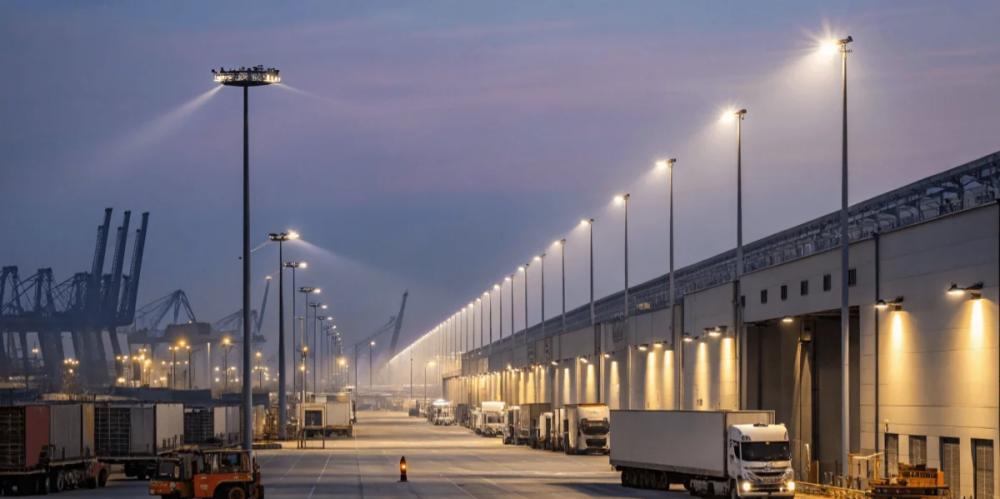
How Fixture Weight and Wind Load Influence Mounting Selection
Fixture weight and wind load directly affect the mounting system’s structural requirements. Multiple floodlights increase the total dead load and projected wind area, placing additional stress on the sports lighting pole and its brackets.
The mounting structure should be selected according to the number, weight, and orientation of the fixtures, together with the pole height and local wind conditions. MORELUX uses structural calculations to customize floodlight brackets, crossarms, and pole designs for specific project loads.
How Aiming Requirements Affect Sports Lighting Mount Selection
The required lighting coverage, beam direction, and glare control determine how much aiming flexibility is needed. Adjustable mounting systems help direct light toward the playing area and support more consistent illumination.
MORELUX considers field dimensions, lux requirements, uniformity, glare control, and fixture aiming angles when developing sports lighting configurations. Slip fitters may suit basic adjustments, while precision brackets and customized headframes can support more demanding lighting layouts.
How Pole Diameter and Mount Compatibility Affect Installation
Pole diameter, top configuration, and fixture connection dimensions must match the selected mounting system. An incompatible bracket can complicate installation and affect structural stability.
Before selecting a mount, confirm the pole’s top design, tenon or mounting plate dimensions, fixture weight, and connection requirements. MORELUX customizes pole dimensions, mounting brackets, and headframes to suit different fixture layouts and project specifications.
How Maintenance Access Influences Sports Lighting Mount Selection
Maintenance access is an important consideration for sports lighting pole mounting options. Fixtures should be positioned and supported in a way that allows safe inspection, adjustment, and replacement without unnecessary downtime.
For larger sports venues, MORELUX offers maintenance platforms, climbing ladders, and customized access systems. Its stadium lighting poles can also include working platforms for routine floodlight inspection and servicing, helping improve maintenance efficiency and operational safety.
Choosing Mounting Options for Different Sports Lighting Applications
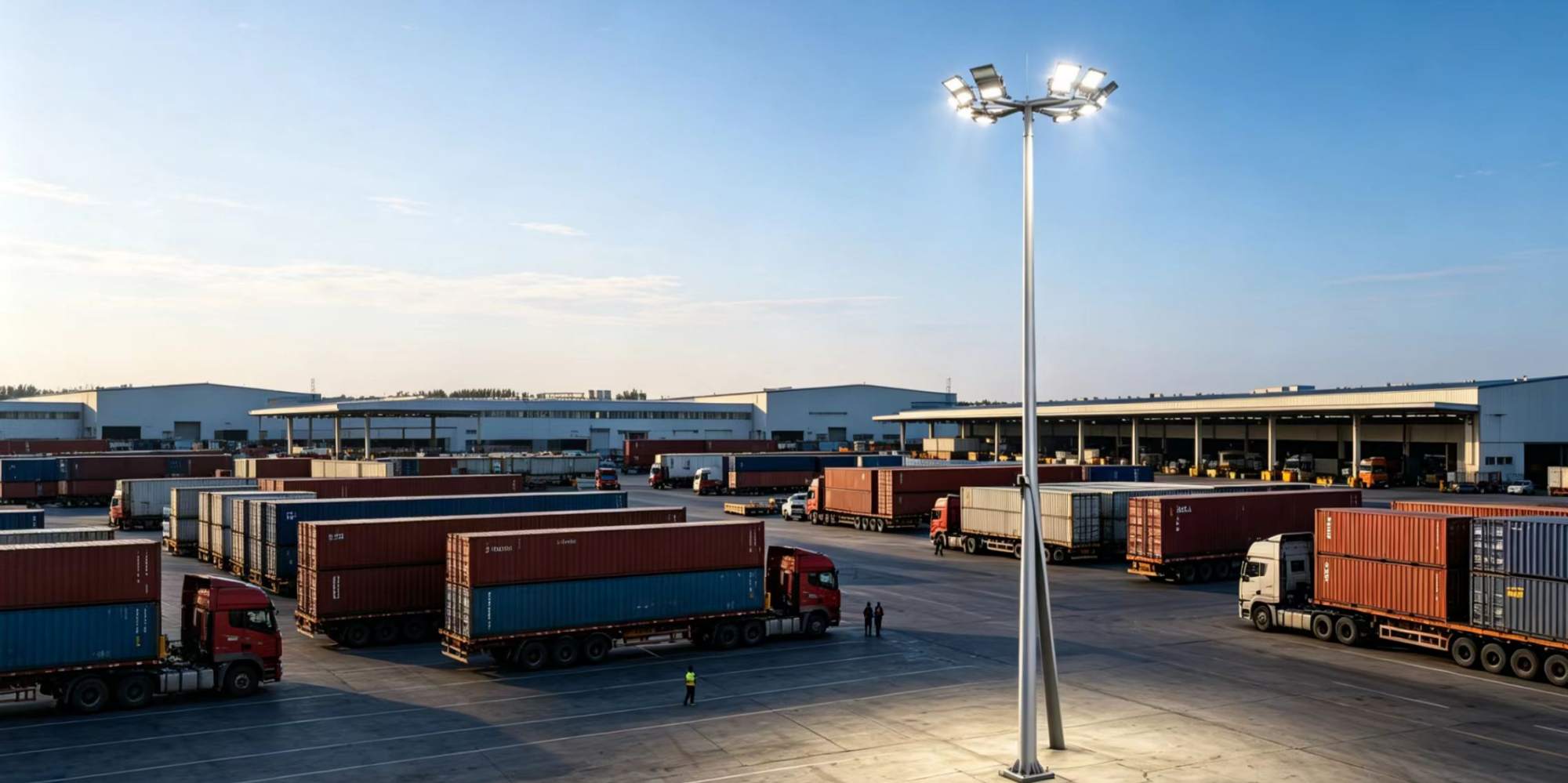
High-mast mounting works well for stadiums and large venues that need to cover a wide area. One or two central poles hold 8 to 16 high-power fixtures, and each one is rated 1200W or more. This setup sends light across the whole field from a single point. Pole height grows with the level of play.
| Sport / Configuration | Recreational | High School/College | Professional/Broadcast |
|---|---|---|---|
| Baseball | 50-60 ft | 70-80 ft | 80+ ft |
| Football | 50-60 ft | 60-70 ft | 70-80 ft |
| Soccer | 40-50 ft | 50-60 ft | 60-70 ft |
| High-Mast (1-2 Central Poles) | — | — | 80-150 ft |
A 25 m pole marks the change from training design to professional stadium lighting. Poles at 35 m and above serve major venues that need broadcast coverage. Stadium high-mast lighting poles usually range from 40 to 55 meters (130 to 180 feet). Lusail Stadium in Qatar uses 12 towers at 52 meters, with 160 luminaires per tower at 1,400W each.
Mounting Options for Stadiums and Large Sports Lighting Projects
High-mast systems need careful maintenance planning because they are so tall. Reaching the luminaires usually takes special equipment and skilled workers.
Accessing service for high-mast luminaires usually requires special equipment and skilled labor.
Lowering mechanisms, easy-to-reach mounting setups, remote monitoring, and maintenance records all cut downtime and risk. Morelux, a steel pole supplier with over 15 years of experience, builds high mast lighting poles tested to BS EN, AASHTO, AS/NZS, and MS standards. The company offers custom pole shapes and finishes for large projects.
Mounting Options for Tennis Courts and Smaller Sports Facilities
Tennis courts and small facilities almost never need high-mast towers. Pole-mounted floodlights on shorter poles give fine aiming control at lower cost. Light levels follow the play level. Recreational courts need 150 to 300 lux with a 3:1 uniformity ratio. Competitive club play needs 300 to 500 lux at 2:1. Professional and TV-broadcast courts need 750 to 1500 lux at 1.5:1. RP-6-22 defines uniformity as the ratio of the highest to the lowest illuminance value. A wholesale or custom bracket matched to the pole tenon keeps aiming stable across the season.
FAQs About Industrial Sports Lighting Pole Mounting Options
What Is the Best Mounting Option for Sports Lighting Poles?
There is no single mounting option for every sports lighting project. The right choice depends on field size, fixture type, pole height, required aiming flexibility, and wind conditions.
For most outdoor sports fields, pole-mounted lighting provides flexible fixture positioning and coverage. Slip fitter mounts suit general aiming adjustments, while trunnion, yoke, and adjustable brackets provide greater control. MORELUX can customize mounting structures according to the fixture layout and project requirements.
How Do Mounting Options Affect Sports Lighting Performance?
Mounting options affect fixture positioning, aiming angles, light distribution, and glare control. A suitable mounting system helps direct light toward the playing area while supporting the required uniformity.
The pole height and fixture arrangement should be considered together with the mounting system. MORELUX develops sports lighting pole configurations based on field dimensions, lighting requirements, fixture positions, and aiming directions.
Can Industrial Sports Lighting Poles Support Multiple Fixtures?
Yes. Industrial sports lighting poles can support multiple floodlights when the pole and mounting structure are designed for the combined fixture weight and wind load.
Crossarms, tenons, and customized headframes can provide multiple mounting points on one pole. MORELUX designs these components according to fixture quantity, weight, orientation, pole height, and project-specific structural requirements.
How Do You Choose Mounts for High Wind Sports Lighting Projects?
For high-wind sports lighting projects, mounting selection should consider fixture weight, projected wind area, mounting height, pole geometry, and local wind conditions. The connection between the fixture, bracket, and pole must also be structurally suitable.
MORELUX uses wind-load and structural calculations to develop customized sports lighting poles and mounting systems. This helps ensure the pole, brackets, crossarms, and fixtures are considered as one complete structural system.
Our Industrial Sports Lighting Poles and Mounting Solutions
Customized Sports Lighting Poles for Different Mounting Requirements
MORELUX provides customized steel sports lighting poles for different fixture layouts and mounting requirements. Pole height, shape, wall thickness, top configuration, crossarms, tenons, and mounting brackets can be developed according to the number, weight, and orientation of floodlights.
The mounting structure can be configured for stadiums, football fields, tennis courts, and other outdoor sports facilities. This allows the sports lighting pole and mounting system to work together as one structural solution.
Engineering Support for Sports Lighting Pole Mounting Solutions
MORELUX supports sports lighting projects with structural design, wind-load calculations, and fixture load analysis. Its engineering team considers pole height, fixture arrangement, mounting structure, and local wind conditions when developing the solution.
With customized engineering support, clients can select suitable mounting options while addressing structural requirements before manufacturing. This helps create a sports lighting pole system designed for the specific site and lighting configuration.