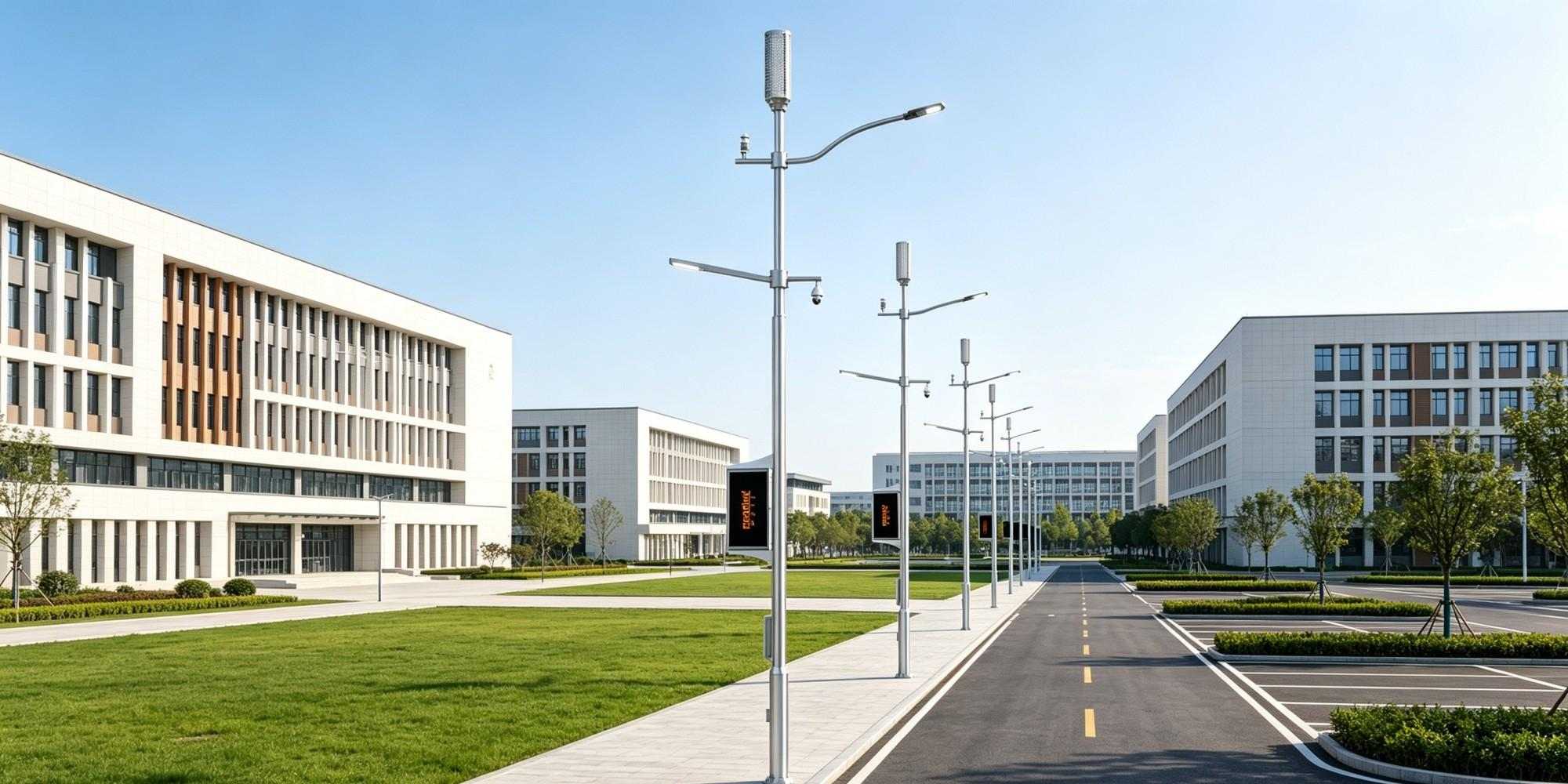

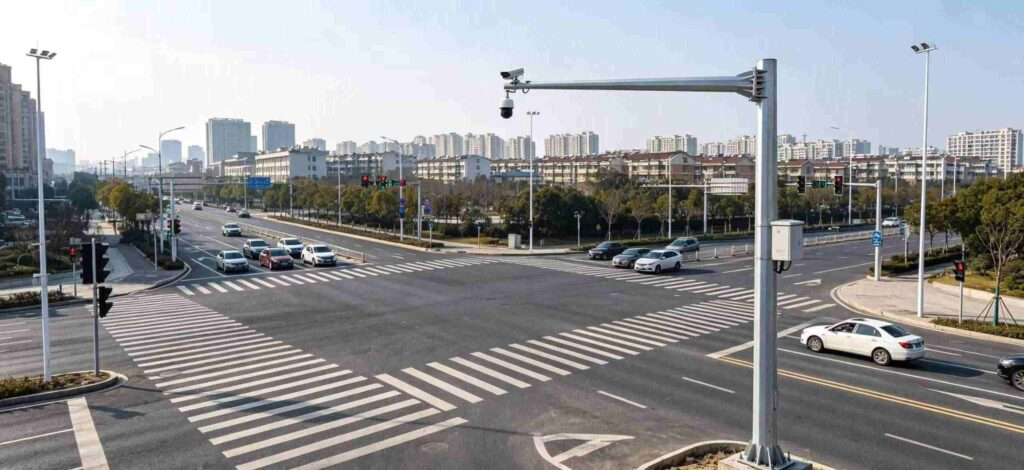
Light poles do more than light up a street. They change how a city feels at night. A good pole helps drivers see, makes walkers feel safe, and defines public spaces. City planners now see lighting as key infrastructure. Safety, beauty, and energy use all rely on it. A smart layout can calm traffic, lower crime, and save power. Bad placement causes glare, dark corners, and wasted energy. Modern poles also hold cameras, sensors, and solar panels. Materials range from galvanized steel to powder-coated finishes. So what really makes these structures vital to city life? The answer is design, engineering, and smart technology.
Key Takeaways
- Light poles make streets safer by cutting down on crashes and crime at night.
- Smart poles use less energy and gather information to help cities work better.
- Picking the right pole height and spacing helps make streets safer and nicer to look at.
- Strong materials such as aluminum and steel keep poles safe from rust and bad weather.
- LED and solar lighting use less power and help cities be greener.
Key Roles of Light Poles in Modern Urban Planning and Design
Light poles are key city structures. They are not just objects on the sidewalk. They light up roads, walkways, and public areas. Without them, cities feel dead at night. Drivers miss lane markings. Walkers cannot tell distances. Public squares stay empty after dark.
Choosing pole height matters a lot. Lights sit on poles because height helps light cover a big area. Taller poles spread light over more lanes. They also let planners place poles farther apart, which cuts cost. Busy city roads use 8–10 meter poles. These light curb to curb across lanes and avoid glare. High-speed highways use 10–12 meter poles. They give drivers steady long-distance vision and need fewer lights per kilometer. Low-traffic streets use 4–6 meter poles. These keep light close to the ground and serve walkers and cyclists without putting out too much light.
These poles also change how people feel about a city. Thoughtful designs make streets and paths look better. They can draw attention to an old building, outline a park, or showcase public art and landscaping. This beauty role is just as important as the useful role. Bright streets invite people outside. Lit parks and plazas bring neighbors together and build community pride.
The facts are clear. Research by the International Association of Lighting Designers shows good street lighting can cut nighttime crashes by up to 30%. Good lighting also stops crime. It helps walkers and cyclists feel safe at crossings and bus stops. The U.S. Department of Energy says LED street lights use about 75% less energy than old sodium lights. So fixture choice matters for the environment. Modern poles are smart too. Eight out of ten urban planners now choose smart poles. These poles save energy and collect live data on traffic and environmental conditions.
In the end, light poles are a key part of city design. They guide traffic, keep people safe, shape the feel of a place, and link residents to their city.
How Light Poles Support Safety and Urban Function
MORELUX is a steel pole manufacturer based in Malaysia. The company runs a factory. It brings engineering experience to every project. MORELUX serves contractors, distributors, and infrastructure clients.
MORELUX makes street lighting poles, solar lighting poles, flood lighting poles, high mast poles, stadium poles, mid-hinged poles, climbing rung poles, stepped pipe poles, CCTV poles, traffic signal poles, telecom monopoles, smart lighting poles, decorative poles, compound poles, and landscape poles. Poles come in square, tapered, round, tubular, octagonal, hexagonal, straight, curved, single-arm, and double-arm styles. Every pole gets a hot-dip galvanized or powder-coated finish. Products are designed in line with the EN 40 series for lighting column design and EN 12767 for passive safety. Structural calculations are checked with professional engineering software before production starts.
Improve Road Safety, Visibility, and Pedestrian Security
Good lighting saves lives. A review of many studies found that better street lighting cuts crime by 14% on average. A randomized field experiment gave causal evidence that better lighting lowers crime. A citywide LED streetlight project in Philadelphia greatly cut outdoor nighttime crime. Later analysis found nighttime foot traffic rose by 4–10%, but crime did not drop most in those busier areas. This suggests crime fell mainly from better natural surveillance and perceived detection, not from more pedestrians serving as guardians.
Pedestrian-scale lighting design connects pole spacing, mounting height, and luminaire distribution to how well people can see. Vertical illuminance at about face height is key for face recognition and personal security. Horizontal illuminance alone is not enough. Uniformity ratios, such as Average-to-Minimum and Maximum-to-Minimum, help find dark gaps. Glare and veiling luminance must also be controlled, usually with full-cutoff optics, because bright sources in a person’s field of view can make it harder to see crossing vehicles or other people.
Support Traffic Flow and Define Public Urban Spaces
Pole placement must meet clear-zone and breakaway rules. If a pole sits farther back, designers should make up for it with optical distribution, not more light output. Spacing should come from mounting height and required uniformity. Maximizing spacing to reduce pole count creates dark zones and hurts safety. Staggered layouts often provide a good balance on main city roads. Intersection lighting is key to safety because more conflicts happen there. Good lighting keeps drivers in their lanes and reduces sudden moves. Lighting should mark curbs, medians, and road edges, reducing run-off-road crashes in tight city spaces.
The Alberta Highway Lighting Guide sets a standard rural pole setback from the edge of the through lane to the face of the pole, unless a barrier protects the pole. LiDAR-based mapping of pole locations can be compared with crash history to find high-risk pole spots and support performance-based placement decisions. These light poles often cause crashes, so giving them a more forgiving clear zone can reduce crash severity and conflict risk.
How Light Pole Design Shapes Urban Aesthetics
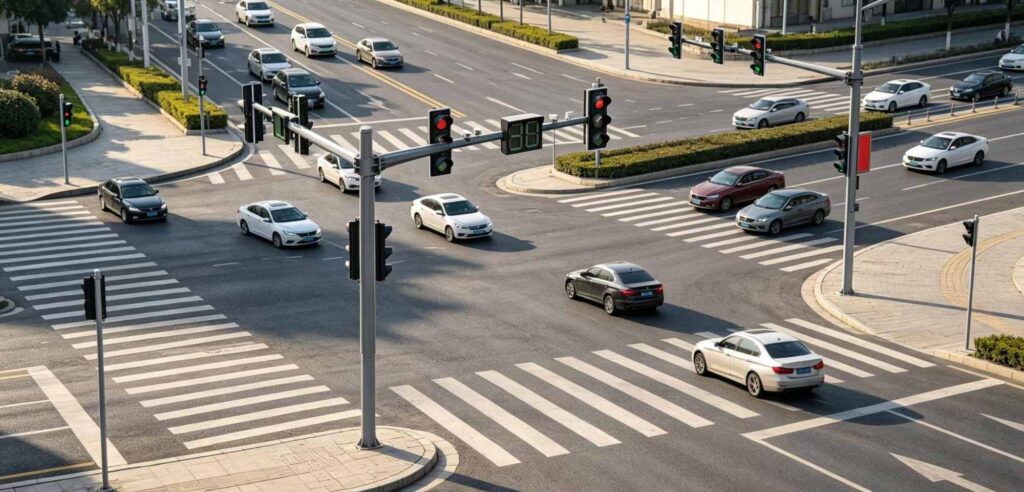
Street lighting poles and fittings make a major impact on the appearance of the road scheme and urban design. They should be planned as part of the overall design, not added at the end. The visual character of a roadscape is shaped by a deliberate convergence of art and technology. The chosen pole and luminaire styles must reinforce the architect’s intended look. The scale, size, location, style, and finish of light fixtures should be coordinated with street furniture and landscaping to achieve aesthetic cohesion.
Match Pole Design With Streetscapes and Public Spaces
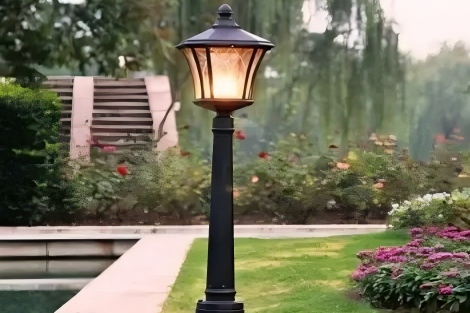
Pole style must match its setting. Ornate poles suit historical districts, while minimalist designs complement contemporary urban areas. Materials range from decorative cast iron to sleek aluminum. Color, texture, and integration with other street furniture establish a cohesive visual theme. Various pole designs complement the surrounding environment, contributing to neighborhood identity and community pride. They help set a mood—welcoming, secure, or vibrant—as areas transition from day to night.
The table below compares pole-top lights and street lights for different urban contexts.
| Consideration | Pole-Top Light | Street Light |
|---|---|---|
| Best suited context | Pedestrian areas, heritage districts, public squares | Traffic corridors, vehicle-priority streets |
| Visual character impact | More human-centered, intimate at moderate heights | Performs better at larger road scale |
| Primary evaluation criteria | Glare control, spill light, nighttime comfort | Optical control, roadway performance |
| Key design question | Does the project involve heritage or streetscape identity goals? | Is roadway performance the main requirement? |
For projects with both conditions, a combined specification using each type where it performs best supports safety, identity, efficiency, and long-term public value. More closely spaced lightposts create a stronger edge along the sidewalk, enhancing safety near doorways and bus stops.
Balance Pole Height, Placement, and Lighting Requirements
Pole spacing should generally relate to pole height. Taller poles can be spaced farther apart because their light spread is wider. Street width affects pole spacing and arrangement. Wider streets require more lighting coverage than narrow streets. Spacing that is too wide creates dark spots, while spacing that is too close creates bright spots. Both reduce roadway lighting uniformity.
For wider streets, poles should be arranged symmetrically on both sides across from each other. For medium-width streets, poles should be staggered or shifted on both sides. For narrow streets, poles should be arranged on one side.
Optical pattern types guide fixture placement and mounting height. Some distributions suit wide walkways and narrow roadways, while others suit conventional roadways. The appropriate road width for a given distribution depends on the mounting height.
Focus lighting directly onto the street to minimize glare and light pollution affecting wildlife and human well-being. Optical shielding blocks direct line-of-sight to the light source. Cutoff and full-cutoff designs direct light downward and prevent upward and horizontal spill. Warmer color temperatures produce less glare and are more comfortable for human eyes than cooler, blue-rich sources. These choices also reduce disruption to nocturnal wildlife and support circadian health.
Selecting Light Pole Materials for Urban Projects
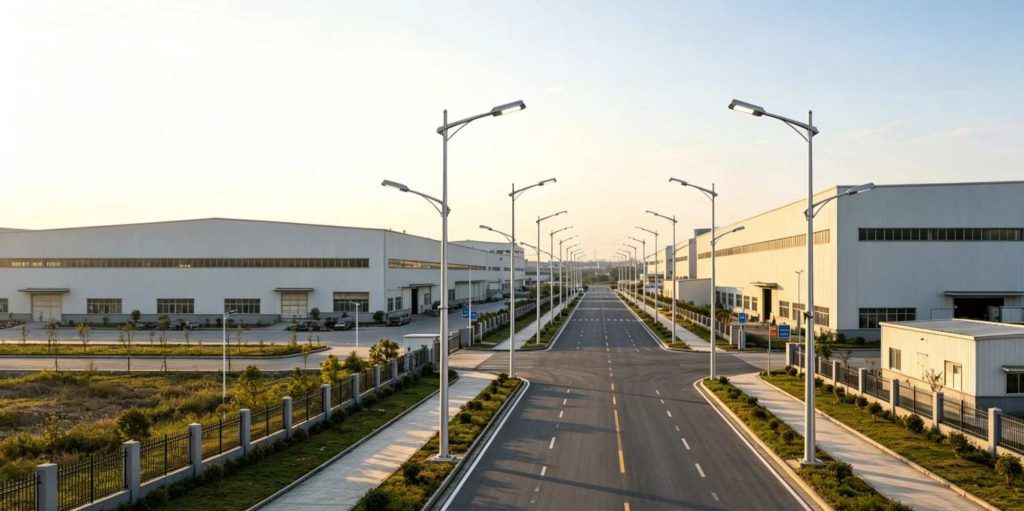
The material you pick decides how long a pole lasts, what it costs, and how well it works. Coastal cities deal with salt spray. Tropical areas get heavy rain and strong UV. Industrial zones add chemical exposure. Each setting needs a different material plan.
Compare Steel and Other Materials for Urban Light Poles
Steel is very strong and handles heavy loads and impacts. It works well on busy roads and in high-wind areas. Steel poles have an upfront cost. They last a long service life. Steel is heavy, so installation needs cranes and bigger crews. Without galvanization, steel rusts.
Aluminum resists rust on its own. It works well in coastal, humid, and tropical climates. Aluminum poles have an upfront cost. Upkeep costs stay low. They last many years. Aluminum is light, so smaller crews can install it. After years near the coast, aluminum usually keeps its look while steel shows major rust damage. Aluminum is also recyclable.
Fiberglass is the lightest choice. It does not rust or rot. Installation is fast and easy, even in hard-to-reach spots. The upfront cost is high, but upkeep is very low. Fiberglass lasts a long service life.
Concrete gives you unmatched durability. It stands up to impacts, weather, and chemicals. It also cuts down vibration. Concrete poles require a high upfront cost. They are the heaviest choice and need special equipment. Upkeep is very low. Concrete lasts a long service life.
The table below sums up the key differences.
| Material | Strength | Weight | Upfront Cost | Maintenance | Lifespan |
|---|---|---|---|---|---|
| Steel | High | Heavy | Low | Moderate | Long service life |
| Aluminum | Moderate | Light | Moderate | Low | Long service life |
| Fiberglass | Moderate | Lightest | High | Very low | Long service life |
| Concrete | Very high | Heaviest | Very high | Very low | Long service life |
For coastal and tropical projects, aluminum housing is the top pick because it resists rust on its own. It cuts upkeep and makes the pole last longer. Steel housing gives you stronger structure for high-wind areas and extra gear loads. Steel needs protective steps in coastal air.
Consider Durability, Corrosion, and Maintenance Requirements
Rust protection decides how long a pole lasts. Hot-dip galvanizing by itself gives good protection in many settings. Powder coating by itself does poorly in harsh climates. Using hot-dip galvanizing with powder coating gives excellent protection. This system works in marine settings.
Hot-dip galvanized poles need simple periodic checks.
ISO 12944 systems need more frequent checks and coating thickness tests. Routine checks include visual checks and coating thickness measurements. Structural checks should happen periodically, or more often in very corrosive settings. Internal drainage holes near the base plate must stay clear to stop internal rust. Small mechanical damage should be fixed by cleaning and applying a zinc-rich primer. Leveling nuts on anchor bolts need re-torquing to keep load spread even.
For coastal settings, marine-grade coatings rated for ISO 12944 C5-M work best. Stainless steel fasteners stop rust. Sealed optics protect electrical parts from salt and moisture. For industrial zones, chemically resistant powder coatings with thicker film builds are suggested. Proper pre-treatment boosts coating adhesion. Regular checks catch undercutting rust or coating chalking.
MORELUX smart lighting poles and solar lighting poles give energy-efficient solutions for urban projects. These poles combine solar power and smart controls. They cut grid dependence and lower operating costs. MORELUX delivered solar poles for the T5 ERS Singapore project. The company also supplied stepped tubular poles for Singapore HDB and NParks. These projects show how material selection and engineering support work together in real urban infrastructure.
Adding Smart and Green Lighting to Cities
Modern cities replace old street lights with LED technology to save energy and help people see better. The right lighting stops accidents, lowers crime, and makes the public safer. Good design also makes spaces useful, welcoming, safe, and nice to look at.
Use LED, Solar, and Energy-Saving Lighting Solutions
LEDs beat high-pressure sodium (HPS) lamps in almost every way. According to the U.S. Department of Energy, LED street lights use about 75% less energy than traditional sodium lights. LEDs turn on right away; HPS lamps need time to warm up.
| Source | Lighting Upgrade | Energy Savings |
|---|---|---|
| U.S. Department of Energy | LED street lights vs. traditional sodium lights | About 75% less energy |
| International Association of Lighting Designers | Proper street lighting | Up to 30% reduction in nighttime accidents |
| Systematic review | Improved street lighting | 14% average crime reduction |
These swaps cut city electricity use substantially. Adaptive controls add further savings.
Solar lighting poles run without the grid. They gather and store power on-site; no trenching or cabling is needed. Commercial solar units match standard street lighting with high-lumen LEDs. They save extra power for cloudy days and short winter daylight. MORELUX delivered solar poles for the T5 ERS Singapore project and stepped tubular poles for Singapore HDB and NParks. Project Ceres in Australia shows global reach.
Plan for Smart Controls and Future Urban Infrastructure
Smart controls turn basic lighting into adaptive systems. Time-based schedules dim lights at set times, saving energy. Motion-triggered boost keeps fixtures at a low output and ramps to full when movement appears, saving energy. Combined time, motion, and ambient sensors save even more.
| Control Strategy | Typical Savings |
|---|---|
| Motion-Triggered Boost | Energy savings |
| Traffic-Responsive Control | Energy savings |
| Combined Adaptive Stack | Additional energy savings |
Open standards matter for Light Poles that must last decades. Proprietary RF technologies become obsolete quickly. Cellular solutions based on global standards offer long-term support. Open standards allow modular smart pole devices from different vendors. Security requires end-to-end encryption, multi-factor authentication, and regular software updates. Future poles must meet standards for wind load, electrical capacity, and cable separation.
Our Custom Light Pole Solutions for Urban Infrastructure Projects
Custom Light Pole Design for Municipal and Urban Applications
MORELUX is a Malaysia-based custom light pole manufacturer supporting municipal and urban projects. Its steel poles can be customized for height, arm configuration, access doors, foundation requirements, and equipment loads.
Poles can be designed for streets, highways, parks, coastal areas, and applications involving cameras, traffic signals, or signage. Structural calculations consider wind, snow, vibration, and other site requirements before manufacturing.
Steel Pole Manufacturing With Engineering and Project Support
MORELUX provides in-house cutting, bending, welding, polishing, coating, and quality inspection. Hot-dip galvanizing to ISO 1461 provides corrosion protection, while additional coatings can support demanding outdoor environments.
The company supports roadway poles, smart poles, traffic poles, solar poles, and flag poles for projects including highways, municipal roads, ports, commercial districts, and parks. Engineering and project support are available from design through production.
Frequently Asked Questions About Light Poles in Urban Planning
Why Are Light Poles Important to Urban Planning and Design?
Light poles support road safety, pedestrian visibility, traffic management, and public-space functionality. Their height, placement, and lighting configuration should be planned with surrounding roads, buildings, parks, and other urban infrastructure.
How Does Light Pole Design Affect Urban Streetscapes?
Light pole design influences both the visual character and function of an urban area. Pole height, shape, finish, arm configuration, and placement can be selected to complement streetscapes while providing the required lighting coverage.
Which Light Pole Material Is Best for Urban Infrastructure?
Steel is a practical choice for many urban infrastructure projects because of its strength, durability, and design flexibility. The appropriate material and corrosion protection should depend on factors such as wind loads, site conditions, pole size, and expected service environment.
How Can Light Poles Support Smart City Development?
Modern light poles can provide mounting points for cameras, sensors, traffic equipment, signage, and other connected devices. Smart pole designs allow cities to integrate additional infrastructure while reducing the need for separate support structures.
What Should Cities Consider When Selecting Light Poles?
Cities should consider pole height, wind and equipment loads, material, corrosion protection, lighting requirements, foundation conditions, and applicable standards. Future equipment needs should also be considered when specifying light poles for long-term urban infrastructure projects.