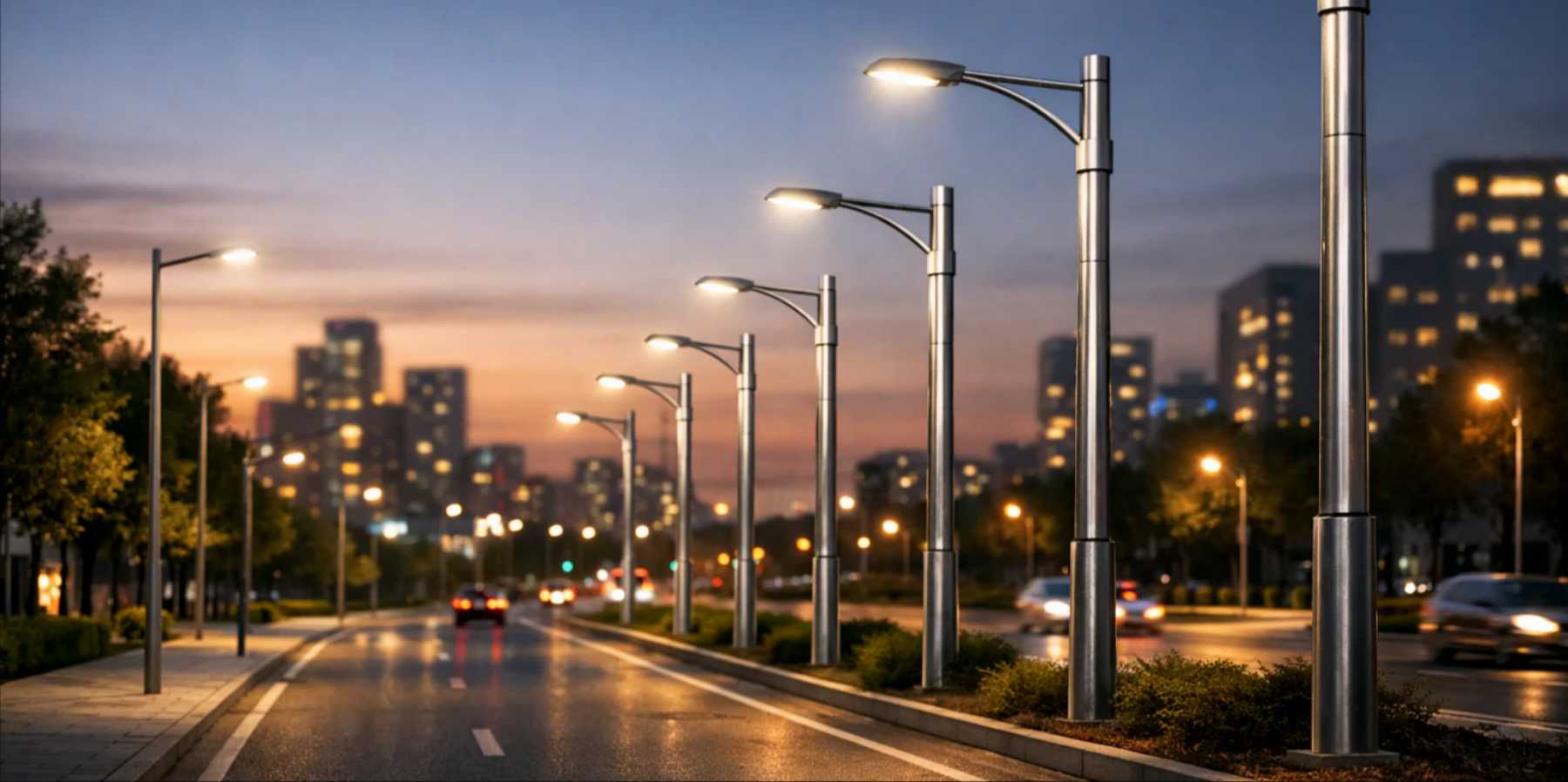


Several groups of rules control high mast lighting poles. The National Electrical Code (NEC) sets rules for wiring, grounding, and circuit protection. IESNA and IES standards define light levels, evenness, and limits on light spilling off the site. State and local building codes control structural safety and permit review. Zoning ordinances decide where a tall pole may stand and how high it may rise.
These rules often overlap. A single project may need an electrical permit, a structural review, and a zoning approval before any steel leaves the yard. Local rules can add to national codes. They can also override them on height, permits, and light spill.
Understanding the regulations for high mast lighting starts with clear definitions. A high mast system usually mounts luminaires in a fixed position on a pole of 20 m (about 66 ft) or more. Some authorities set a different threshold.
Key Takeaways
- High mast lighting rules come from national codes, local laws, and international standards. These rules cover electrical safety, structural design, and limits on light.
- You must design poles for wind loads at the specific site. Use the right steel grade and coating. This prevents structural failures and costly repairs.
- Follow electrical codes for wiring, grounding, and surge protection. This keeps workers safe and stops damage to equipment.
- Check local height limits and light trespass rules early. This avoids permit delays and fines.
- Keep detailed records of inspections and maintenance. This shows you follow the rules and helps you fix problems fast.
Which Regulations and Standards Apply to High Mast Lighting Systems?
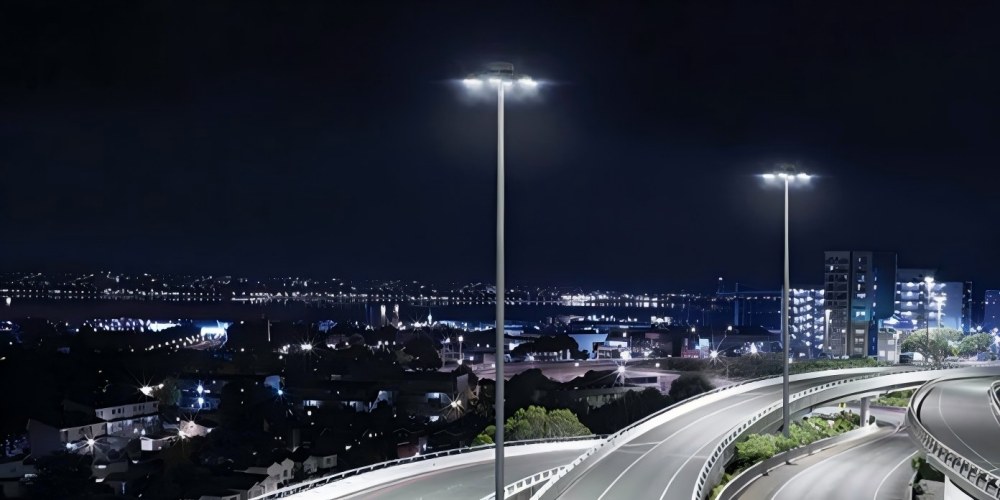
High mast lighting means luminaires mounted in a fixed orientation at the top of a tall pole to illuminate large outdoor areas, generally 20 m (about 66 ft) or more. Definitions vary by authority. Typical high mast poles exceed 50 ft and sometimes reach up to 150 ft.
A clear hierarchy governs these systems. National codes such as the NEC and IESNA/IES standards set the baseline. State and local ordinances may add to that baseline or override it on height, permits, and light trespass. The regulations for high mast lighting therefore work as layers, not as a single rulebook.
How Local Building Codes and Electrical Standards Govern Installations
Local zoning ordinances turn national rules into limits for a specific site. Caps on light trespass are a common example. Many communities allow no more than 0.5 footcandle at a residential property line and 1 footcandle at a non-residential line or public right-of-way. Some set the residential limit much lower, measured 3 ft above the ground at the property line.
Height limits often follow land use. A general non-residential pole may be capped at 18 ft with fully shielded luminaires. Industrial uses in designated industry centers may reach 75 ft when not abutting residential land. An industrial pole abutting residential land is usually limited to 50 ft, with relief available through setback. Poles at outdoor recreational facilities commonly top out at 60 ft. Unshielded lighting is usually prohibited.
High mast lighting should not be installed in areas where light trespass is an issue, generally areas where residential development is located directly along the highway right-of-way and pole placement is limited to the outside of the roadway.
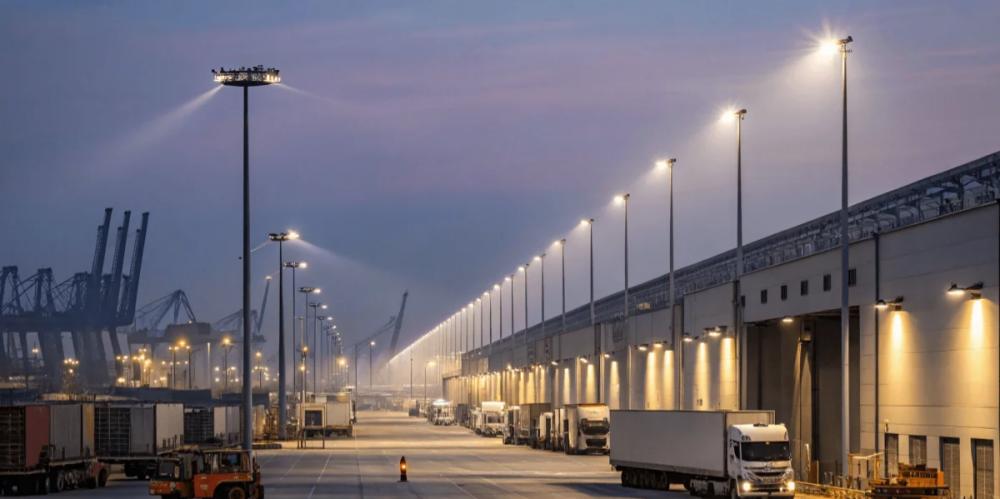
These poles serve interchanges, ports, and large industrial lots. They carry multiple high-lumen fixtures on one structure and often include motorized lowering ring systems for ground-level maintenance. Foundations require deep concrete caissons and anchor bolt cages to resist overturning moments.
How International Standards Apply to High Mast Pole Design and Testing
Pole design and testing draw on named international standards. Each covers a defined scope.
| Standard | Region | Scope |
|---|---|---|
| EN 40-3-1 / EN 40-3-3 | Europe | Structural design of lighting columns and high masts |
| AASHTO LTS-6 | North America | Structural specifications for luminaire support structures |
| AS/NZS 1158.6 | Australia / NZ | Lighting for roads — structural requirements |
| GB 50135 | China | Design standard for high-rising structures (poles over 20 m) |
| ISO 1461 | International | Hot-dip galvanizing — coating thickness and adhesion |
Wind loading follows its own family: EN 1991-1-4, ASCE 7, and AS/NZS 1170.2. Welding quality is checked against AWS D1.1 or EN ISO 15614. Coating durability is verified under ISO 1461 or ASTM A123. A compliant pole usually cites several of these standards together, not one alone.
Structural Design Requirements for High Mast Lighting Poles
Structural design turns the rules for high mast lighting into a safe pole that can be built. Wind load analysis, foundation design, and coating durability all go into one structural package. Poles are often designed and tested to international standards like BS EN, AASHTO, AS/NZS, and MS specifications.
How Wind Loads and Pole Height Affect Structural Design Requirements
Wind speed goes up with height in open terrain. So stress at the top of a tall pole is much higher than near the base. This vertical wind profile sets the taper and wall thickness of the shaft. Designers also check the mast’s natural frequency and size reduction factor, and both depend on pole height.
Wind zones guide the math. Reference speeds run from 28 m/s or less in sheltered inland sites to 48 m/s or more in typhoon zones, measured at 10 m height in open terrain. AASHTO and NESC each publish their own wind load formulas. Taller poles get stronger gusts up high, so they need higher structural wind ratings.
How Steel Grades, Wall Thickness, and Corrosion Protection Affect Compliance
Steel grade and wall thickness must come from a structural calculation, not a catalog default. A higher grade like S355 carries more load in the same section, or allows a thinner wall at lower weight. A half-millimeter cut in wall thickness is invisible on drawings but significant under wind moment.
| Factor | Effect on Structural Compliance |
|---|---|
| Steel grade (S355 vs S235) | Higher yield strength carries more load or permits a thinner wall |
| Wall thickness | Must follow structural calculation for the specific height and wind zone |
| Verification | Grade should be specified in writing, e.g. S355, not “high-strength steel” |
Coating choice matters too. Hot-dip galvanizing to ISO 1461 is the standard baseline. Powder coating alone is not recommended. A duplex system of galvanizing plus powder coating meets ISO 1461 and ISO 12944 together.
For the highest level of protection in C4 and C5 environments, municipalities often specify both hot-dip galvanizing and powder coating for poles.
As a custom high mast pole manufacturer and supplier, Morelux provides design drawings, structural calculations, and wind load analysis, with wholesale options for contractors. Regular structural checks and coating inspections keep a pole compliant over its service life.
Electrical Safety and Grounding Requirements for High Mast Lighting
Electrical rules keep people and equipment safe on a structure that few workers can reach easily. The regulations for high mast lighting treat the pole as both a wiring raceway and a grounded steel column. Both roles need attention at the design stage.
How Wiring, Grounding, and Circuit Protection Affect Electrical Compliance
The NEC sets the baseline for conductors, raceways, and enclosures on a high mast pole. Wiring must fit the outdoor environment. Conductors run inside the pole or in a protected raceway. Splices belong in listed enclosures, not out in the open.
A grounding electrode conductor must connect the steel pole to earth. The equipment grounding conductor bonds every luminaire housing and every metal part. A visible, lockable disconnect must sit at the base. This lets a technician cut power before climbing or lowering the ring.
Circuit protection must match the load. Each luminaire circuit needs overcurrent protection sized to the conductor and the fixture. A motorized lowering system adds its own circuit and its own disconnect. Some jurisdictions may require ground-fault protection for outdoor circuits.
Illumination rules come from IESNA/IES standards. These standards set recommended light levels, uniformity ratios, and limits on light trespass. Designers estimate coverage from mast height, optic type, spacing, and target lux. They then confirm the result with actual IES or LDT photometric files in DIALux. A simulation beats a catalog claim every time.
How Lightning Protection and Surge Control Improve Installation Safety
A tall steel pole in open ground attracts lightning. A lightning protection system gives the strike a safe path to earth. Air terminals at the top, a down conductor, and a grounding electrode form that path. The pole itself can serve as a natural down conductor when bonded correctly.
Surge protective devices guard the luminaires and drivers. A strike nearby sends a voltage spike down the conductors. A surge device at the base panel stops that spike before it reaches the fixtures. Driver failures often trace back to missing surge protection.
The common ring-of-floodlights layout sits at 20 to 40 m. Luminaire selection and pole height affect each other directly here. A taller mast spreads light over a wider area with fewer fixtures. A shorter mast needs more fixtures or tighter optics. Either choice must still meet the photometric targets in the approved plan.
Check the grounding and surge design against the local electrical code before the foundation is poured. Retrofits on a standing mast cost far more than a change on paper.
Foundation, Anchor Bolts, and Installation Compliance Requirements
Foundation work turns the design into a structure that resists overturning. Wind loads calculated for the pole become a design bending moment. That same moment becomes the overturning moment for the foundation. This load case controls the foundation size.
How Soil Conditions and Wind Loads Determine Foundation Requirements
The foundation must be sized so the overturning moment stays within the soil’s allowable bearing capacity. A geotechnical engineer confirms that capacity through site tests before detailed design.
| Foundation Type | Resisting Mechanism | Minimum Soil Bearing Capacity |
|---|---|---|
| Unreinforced concrete, passive | Vertical and lateral soil bearing | 150 kN/m² |
| Unreinforced concrete, non-passive | Vertical bearing only | Standard designs above 75, 100, and 150 kN/m² |
| Reinforced pad with plinth | Vertical bearing | Standard designs above 75, 100, and 150 kN/m² |
Concrete quality follows the foundation type. Unreinforced foundations need at least C20/25. Reinforced foundations need C28/35, cement content of at least 300 kg/m³, and a water/cement ratio no higher than 0.60. Leave the concrete at least 14 days before loading or pole installation.
How Anchor Bolt Layout and Pole Installation Must Match Approved Drawings
Anchor bolts follow the manufacturer’s dimensions, never a generic table. ASTM F1554 governs most light pole anchor bolts in the United States. Grade 55 is the most commonly specified grade, while Grade 105 suits high-mast and heavy-duty poles. Embedment depth should reach 12 times the bolt diameter.
Installation runs under an approved method statement. Excavation follows approved drawings and utility-locate requirements. The anchor bolt template is set to the manufacturer’s specifications, and concrete is placed while the template holds position. The pole goes up only after the concrete reaches specified strength.
Sign-off depends on records, not assurances. Measurement records cover the bolt circle, projection, and verticality. Inspection photos document thread and coating condition. A signed hold-point release confirms civil and mechanical approval before erection. These checks keep the regulations for high mast lighting satisfied at every stage.
Inspection, Maintenance, and Safety Regulations for High Mast Lighting
Breaking these rules has real costs. Common penalties include fines, stop-work orders, permit revocation, required retrofits, and liability after a failure. A stop-work order can halt a project until the drawings are fixed. A revoked permit may force a full resubmittal. Liability grows sharply after a structural or electrical failure, so the cheapest path is to comply before erection.
Ongoing compliance depends on documented inspection. There is no single global maintenance interval. The schedule should follow owner requirements, local authority rules, OEM instructions, project risk level, operating hours, and environmental exposure. Coastal and corrosive sites need closer attention than dry inland sites. Past failure history and lowering-system condition also shape the plan. The owner or responsible maintenance authority should approve the final schedule in writing.
| Maintenance Area | What to Check | Required Record |
|---|---|---|
| Luminaire | Output, lens, housing, bracket, driver condition | Inspection photo / record |
| Optic / aiming | Lens condition, orientation, tilt, rotation, dark zones | Aiming or visual inspection record |
| Lowering system | Ring, wire rope, winch, latch, guide system | OEM-based inspection record |
| Electrical system | Cabinet, SPD, grounding, cable, control | Electrical test / inspection record |
| Pole and base | Coating, corrosion, anchor area, access door | Visual inspection record |
| Lighting performance | Night visual check or measurement | Measurement record if required |
Recordkeeping backs up every claim and every warranty request. Keep the commissioning record, as-built layout, luminaire model and serial list, aiming schedule, electrical drawing, lowering-system manual, inspection checklist, spare-parts plan, and maintenance log. After each service visit, file the checklists, photos, electrical test records, replacement logs, surge device records, and night performance records. These documents prove compliance during an audit and speed up fault tracing later.
Re-checking matters after any retrofit. A new luminaire model or a changed aiming schedule can shift light levels and light trespass beyond the approved plan. Update the photometric file and confirm the result against the original limits. Stay current with local ordinance updates too, since height caps and trespass limits change over time. Treat the regulations for high mast lighting as a living checklist, not a one-time gate.
Common High Mast Lighting Compliance Mistakes and Their Consequences
Most compliance failures start on paper, not on the pole. A design team copies a wind load from an old project. A contractor submits a photometric plan built on catalog claims. Each shortcut looks harmless at review. Each one shows up later as a structural problem, a rejected permit, or a failed inspection.
Why Ignoring Site-Specific Wind Loads Can Create Structural Risks
Wind load depends on terrain, exposure, and local wind speed. A pole designed for a sheltered inland site may fail at a coastal or open site. Designers must use the wind data for the actual location, following standards such as EN 1991-1-4, ASCE 7, or AS/NZS 1170.2. A generic value from a similar project does not meet this requirement.
The damage builds slowly and quietly. Common outcomes include:
- Progressive fatigue at structural connections
- Bolt loosening leading to repeated maintenance
- Grout breakdown and water ingress
- Pole tilt or loss of plumb
- Lighting outage in critical areas
- Property damage or injury risk
- Approval, acceptance, or insurance complications
These problems rarely show up on day one. They appear over seasons of wind cycling. By then, repairs cost far more than a correct calculation at the design stage.
How Incorrect Lighting Levels and Incomplete Documentation Delay Approval
Reviewers check light levels against IESNA/IES targets and local trespass limits. A plan that misses the target lux or spills light past the property line will not pass. Catalog claims do not count. The reviewer expects a simulation built from actual IES or LDT photometric files in DIALux, matched to the chosen mast height and optics.
Documentation gaps stall projects just as often. Missing structural calculations, outdated anchor bolt drawings, or an absent aiming schedule trigger resubmittal. Each cycle adds delay and review fees. A complete package — calculations, photometric plan, and installation drawings — clears review faster and protects the owner after handover.
The rules for high mast lighting fit into five groups. Scope and definitions set the pole height threshold. Structural safety covers wind loads, steel grade, and corrosion protection. Electrical and illumination standards govern wiring, grounding, and light levels. Permitting and penalties decide whether a project moves forward or stalls.
Following the rules protects people and avoids fines and stop-work orders. It also keeps a pole working for decades. Check local requirements early in the design stage. Confirm wind data, trespass limits, and permit documents before building starts. Then talk to qualified engineers and electricians before installation. Careful checks at the start cost much less than a retrofit on a standing mast.
Frequently Asked Questions About High Mast Lighting Regulations
What Standards Apply to High Mast Lighting Pole Design?
High mast lighting pole design standards depend on the project location, application, and local regulations. Common references include AASHTO for roadway lighting structures, relevant BS EN standards for applicable European projects, and AS/NZS standards in Australia and New Zealand. Buyers should confirm the required structural design, materials, fabrication, and corrosion protection standards before manufacturing.
Is There a Standard Height Limit for High Mast Lighting Poles?
There is no single height limit that applies to every high mast lighting project. Permitted height depends on local regulations, site conditions, wind loads, lighting requirements, and structural design. MORELUX provides customized steel high mast poles, with heights determined by project specifications and engineering calculations.
Are High Mast Lighting Poles Required to Meet Wind Load Standards?
Yes, high mast lighting poles generally need to be designed for applicable wind loads and local structural requirements. Calculations should account for pole height, mounted luminaires, accessories, projected wind area, and site-specific wind conditions. MORELUX provides wind-load analysis and engineering support to help ensure its steel poles meet project design requirements.
How Often Should High Mast Lighting Systems Be Inspected?
High mast lighting systems should be inspected at intervals based on local regulations, manufacturer recommendations, operating conditions, and maintenance plans. Inspections should cover the pole shaft, base connections, anchor bolts, welds, corrosion protection, luminaires, and raising or lowering mechanisms where fitted. Sites exposed to strong winds or corrosive environments may require more frequent checks.