
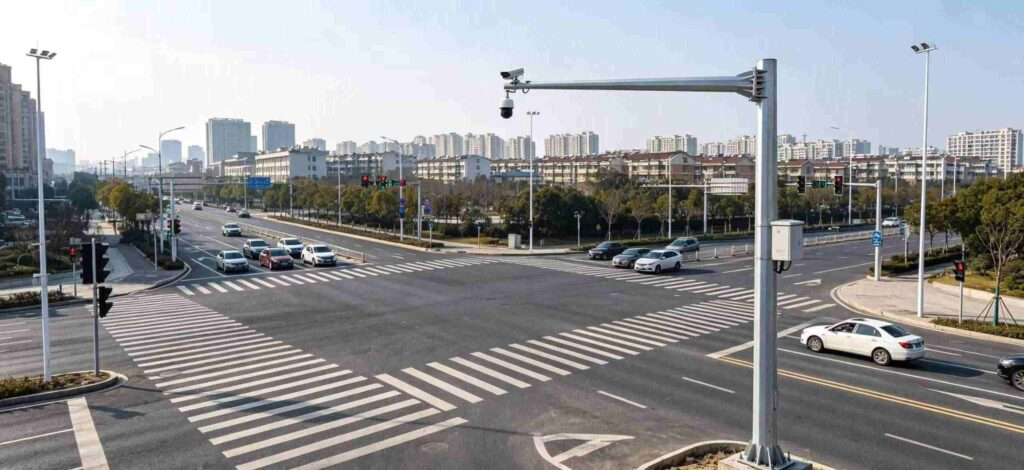
There is no single pole height that works for every CCTV setup. Most general surveillance systems use poles about 8 to 10 feet (2.4 to 3 meters) tall. This height puts the camera above most things that block the view. It also keeps the housing close enough to reach for maintenance.
Several trusted groups publish more specific advice. These include the Security Industry Association (SIA), the New York Police Department (NYPD), the Australian Government, and the UK Home Office. Each one gives its own advice for mounting CCTV poles. Their numbers differ because each source is trying to meet a different security goal. Site conditions, what the camera is for, and local rules also affect the final choice.
Key Takeaways
- Most regular CCTV systems use poles that are 8 to 10 feet tall. This height gives clear views and still makes upkeep easy.
- Different security goals need different heights. For example, facial recognition works best with lower mounts. Wide-area surveillance, on the other hand, needs taller poles.
- Taller poles make it harder for people to mess with the camera, but they may make faces less clear. Shorter poles get better face shots, but they are easier for people to reach.
- Always think about what the camera is for and what the site is like. A professional can help pick the right height for your needs.
- Things like pole thickness and wind load are important structural factors. A strong pole keeps the camera safe and steady.
What Is the Recommended Height for a CCTV Camera Pole?
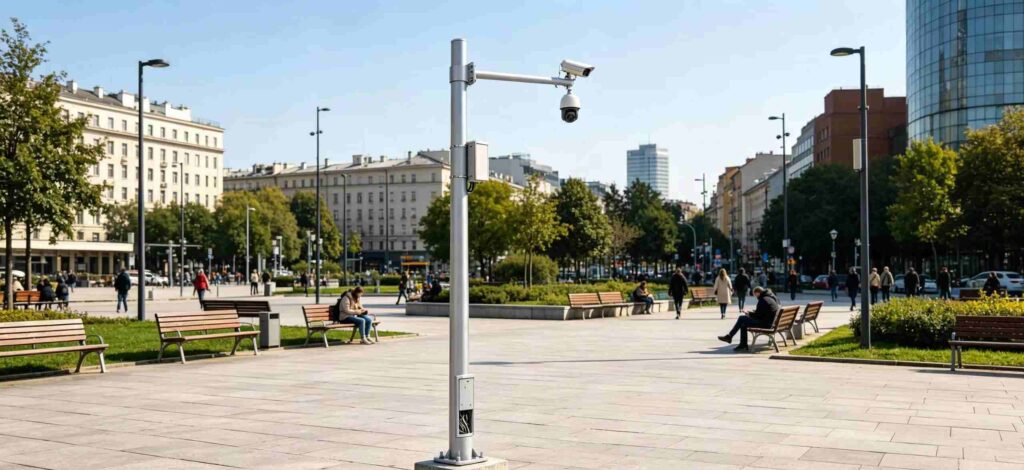
The Security Industry Association (SIA) recommends a mounting range of roughly 8 to 10 feet (2.4 to 3 meters) for general surveillance. This range works well for several reasons. The camera sits above parked cars, shrubs, and most pedestrians. The lens still points down at a usable angle for faces and activity. Maintenance crews can reach the housing with a standard ladder.
The New York Police Department (NYPD) advises 10 to 12 feet (3 to 3.7 meters) for general outdoor surveillance. The extra height clears dumpsters, fences, and low signage. It also lifts the camera above easy reach. A person on the ground cannot grab the housing or block the lens by hand.
How Standard CCTV Pole Heights Vary by Application and Site
Parking lot systems often need taller poles. A lot with rows of vehicles, light fixtures, and trees may require poles from 10 to 30 feet. The goal is a clear sight line over obstructions. A short pole in a large lot leaves the camera staring at the back of a truck.
Specific camera tasks set their own targets. A license plate recognition (LPR) camera on a pole may sit at about 9 feet. A call-tower camera may mount at about 12 feet. These figures show how the job shapes the height. A camera watching a wide lot and a camera reading plates do not share the same ideal position.
How Camera Viewing Angles Influence CCTV Pole Height Selection
Height and viewing angle move together. A higher camera looks down more steeply. A steeper angle compresses plate characters and shortens the visible face. LPR guidance reflects this trade-off. Some LPR cameras work best mounted 3 to 6 feet above ground, where the plate is captured at a shallow angle. Other kits accept higher mounts. The AXIS P1485-LE Kit supports heights from 3 to 10 meters (10 to 33 feet), with capture distance growing as the mount rises. The AXIS P3285-LVE Kit works up to 3 meters (10 feet). Mounting above headlight level also helps avoid glare.
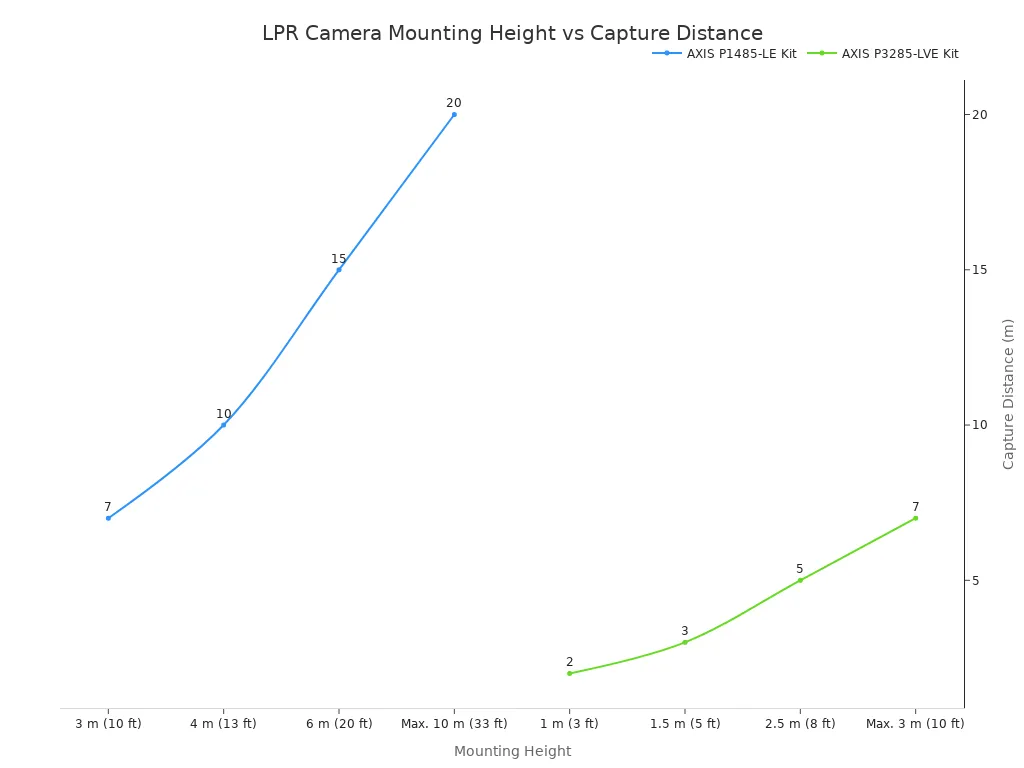
For home driveway capture, an LPR camera may sit 2 to 3 feet above the roadway, aimed at approaching vehicles at headlight height. The right CCTV pole height therefore depends on what the lens must see, not on a single fixed number.
What CCTV Pole Heights Suit Different Security Applications?
What CCTV Pole Height Works Best for Residential and Commercial Sites?
The Australian Government puts out guidance on how high to install security cameras. Its advice balances two goals. A higher mount keeps the camera safe from tampering. A lower mount captures faces at a good angle for identification. Facial recognition needs a clear, fairly straight-on view of the person. A camera pointed steeply down from a tall pole loses that view. So when identification matters, homes and businesses should lean toward the lower end of the general range.
The UK Home Office looks at it a different way. Its suggested mounting height focuses on stopping tampering. A camera placed well above the ground is harder to reach, damage, or cover. This thinking fits shops, offices, and apartment entrances, where the camera must keep working all night. The trade-off is the same one the Australian guidance points out. Higher placement protects the hardware but weakens facial capture. Property owners should match the height to the site’s main risk.
What Pole Height Supports Industrial Sites and Wide-Area Surveillance?
Industrial sites need height to see over obstructions. Warehouses commonly use poles of 12–16 ft for a wide view and broad monitoring. A 10–12 ft pole gives a wider view for watching large areas. Where cameras must see over parked trucks, fences, and berms, an 18 ft pole works better. The extra 2 ft lifts the camera to about 17.6 ft and puts it further out of reach. A 16 ft pole suits rooftops, decks, and short sight lines.
More height is not always the answer. For a large industrial yard, two or three shorter poles will usually beat one very tall pole. A single pole creates a blind spot right beneath it and spreads the pixel budget thin at the edges. Spreading cameras across several moderate poles keeps coverage even. This approach also gives maintenance crews easier access to each CCTV pole.
How Does CCTV Pole Height Affect Image Quality and Coverage?
No single mounting height works for every goal. A high mount stops tampering and gives a wider view. It also records hairlines and shoulders instead of faces. A low mount captures clear facial detail. It also leaves the housing within easy reach of a vandal. The right CCTV pole height falls between these two outcomes, and the balance point shifts with each site.
How Mounting Height Affects Facial Recognition and License Plate Capture
Face capture depends a lot on camera position. Cameras mounted at roughly five to six feet line up with average human face level. A position slightly above eye level cuts glare and shadows that lower recognition accuracy. A general baseline is about 9 feet with a 25-degree downward tilt, holding at least 137 pixels per foot. Faces should be captured frontally, not from harsh side angles.
| Mounting Height | Effect on Facial Recognition |
|---|---|
| Eye level (5–6 ft) | Best for entry points; full-frontal features, high accuracy |
| Overhead (8–10 ft) | Deters tampering, widens view; works best in corridors |
| High-mounted (12–15 ft) | Suited to large public spaces; needs tilt and zoom to keep clarity |
Placing a camera too high causes image distortion. The 8–10 ft band is the practical sweet spot. It stays high enough for a usable face of someone approaching and low enough to avoid casual tampering. Above 12 ft, identification becomes unreliable.
How Pole Height Influences Camera Field of View and Blind Spots
Height extends outward range and makes the blind spot directly beneath the camera larger. More downward tilt shrinks that blind spot but pulls the top of the frame down and cuts range. A wider vertical field of view sees more ground at the same height and tilt. Common mistakes include mounting too high, tucking cameras into corners, and ignoring obstacles.
Recommended bands follow the purpose. Use 2.5–3 m (8–10 ft) for facial identification and 3.5–5 m (12–16 ft) for general area coverage with an accepted blind spot. Above 5 m (16 ft) suits overview only and needs a second lower camera for identification. A field of view of at least 120° also helps cover more area with fewer units. Site grading matters too. Traffic signal camera pole foundations are designed for level ground or slopes not exceeding 2H:1V.
What Structural Factors Matter When Choosing CCTV Pole Height?
Height is only half of the decision. The pole must also hold the camera safely for many years. A structural expert should match pole height to the exact site and what the camera is for. Soil type, wind zone, and the total load at the top of the pole all shape the final design.
Common standard sizes give you a starting point. A 10-ft round steel pole with a 3-inch diameter and an anchor base fits many light-duty camera setups. Bigger sites often need heavier sections. A custom steel pole manufacturer can build to the exact height and load the project needs.
How Steel Pole Height and Wall Thickness Affect Structural Stability
Wall thickness works together with height. Taller poles face a bigger bending force from wind and height. Thicker walls bring back stability.
| Pole Height | Typical Wall Thickness | Structural Implication |
|---|---|---|
| 5–6 m | 2.5–3.0 mm | Lower bending force; good for light-duty CCTV in sheltered areas |
| 7–9 m | 3.0–3.5 mm | Moderate bending demand; city and street surveillance |
| 10 m and above | 4.0–5.0 mm | High bending force from wind and height; needs a heavier section for stability |
Thicker walls raise bending resistance and load capacity. They improve wind resistance and reduce too much bending. They also add resistance to vibration and fatigue under repeated loading. A corrosion allowance keeps structural margin over the service life.
Pole stiffness depends on more than diameter. Material, wall thickness or pole class, shape and taper, above-grade height, camera and bracket weight, arm length, wind exposure, foundation, and hardware stiffness all play a part. Camera performance follows pole movement. PTZ, long-range, and LPR cameras in exposed spots need a closer look at bending and wall construction.
How Camera Weight and Wind Loads Influence CCTV Pole Design
No official design guideline exists for surveillance poles alone. Projects are a team effort between a security specifier and a civil or structural engineer. The engineer sizes the foundation from soil type, wind zone, pole height, and total load. That load includes the camera, housing, cabling, and wind-catching accessories.
Cameras handle sway at the top of the pole far less than lamps do. A full camera package can also weigh much more than a light head. Both facts change the diameter and reinforcement you need. The base, not the height, is what usually fails in a storm. Direct-buried, anchor-base, and ballast mounts carry different wind-load ratings and failure modes.
Buyers should check the pole’s rated wind speed against the site’s design wind speed under the current building code. They should also confirm the total load at the top of the pole is within spec. An EPA (effective projected area) table helps match load and wind ratings before you buy.
Morelux, a Malaysian custom steel pole manufacturer, builds CCTV poles in custom heights and square, tapered, round, or octagonal shapes. Finishes include galvanized and powder-coated options. Designs are tested to BS EN, AASHTO, AS/NZS, and MS standards. The engineering team supplies design drawings and wind load analysis for each project.
Our Custom Steel CCTV Pole Solutions for Security Projects
How MORELUX Customizes Steel CCTV Pole Heights and Configurations
MORELUX customizes steel CCTV poles to meet project requirements, including pole height, wall thickness, shaft shape, mounting arms, base plates, and surface finishes. Options include round, square, tapered, octagonal, and hexagonal designs, with single or double arms.
Hot-dip galvanizing, powder coating, and duplex systems are available according to site conditions. In-house manufacturing processes help maintain dimensional consistency across production runs.
How Structural Calculations Support Project-Specific Pole Requirements
CCTV pole design must account for pole height, camera weight, mounting positions, and wind loads. MORELUX provides technical drawings, structural calculations, and wind load analysis to support project-specific specifications.
With over 15 years of experience and exports to more than 30 countries, MORELUX supports customized steel pole projects from design through production. The appropriate CCTV pole height should also reflect camera coverage, tampering risks, and local requirements.
Frequently Asked Questions About CCTV Camera Pole Heights
What Is the Standard Height for an Outdoor CCTV Camera Pole?
There is no single standard height for every outdoor CCTV camera pole. Shorter poles may suit entrances and parking areas, while taller poles can provide wider coverage. The ideal height depends on camera type, viewing angle, site layout, and mounting requirements.
Can a CCTV Camera Pole Be Taller Than 20 Feet?
Yes. Steel CCTV poles can exceed 20 feet (6.1 m) when the application requires greater camera elevation or coverage. However, taller poles need structural calculations that account for wind loads, camera weight, wall thickness, and foundation capacity. MORELUX provides customized steel poles and wind load analysis for project-specific requirements.
How Deep Should the Foundation Be for a Tall CCTV Pole?
Foundation depth depends on pole height, wind loads, soil conditions, and the foundation design. There is no universal depth suitable for every installation. A qualified engineer should determine the foundation dimensions, embedment depth, and anchor bolt requirements based on site conditions and structural calculations.
How Do I Choose the Right Steel CCTV Pole Height for My Project?
Consider the required surveillance area, camera viewing angle, mounting equipment, and potential obstructions. Then assess local wind conditions, pole strength, and foundation requirements. MORELUX offers customized steel CCTV poles with structural calculations and technical drawings to support project-specific designs.