Galvanized steel is the best overall material for camera poles. It offers high strength, moderate cost, and proven outdoor durability. Hot-dip galvanizing adds a protective zinc layer. That layer fights rust for years of permanent use.
The best choice can still change. Budget, climate, and mounting load all matter. A coastal site needs more protection from corrosion. A heavy camera head needs more structural strength. A tight budget may favor another option.
No single material wins every project. Aluminum, fiberglass, concrete, and wood each have specific roles. A CCTV pole must match its site and its load. Material selection deserves careful thought before you buy.
Key Takeaways
- Galvanized steel is the best all-around material for camera poles. It is strong, costs a fair amount, and lasts a long time outdoors.
- Pick aluminum for areas near the coast. It fights rust and is light, so it is easier to install.
- Pick the pole material that fits the place: steel for heavy cameras and strong winds, aluminum for salty air, and wood for low-cost rural setups.
- Always include the weight of cameras and accessories when you design the pole. This prevents failure and keeps things safe.
- Use galvanizing and coatings to protect steel poles and make them last longer, especially in harsh conditions.
What Materials Are Commonly Used for CCTV Camera Poles?
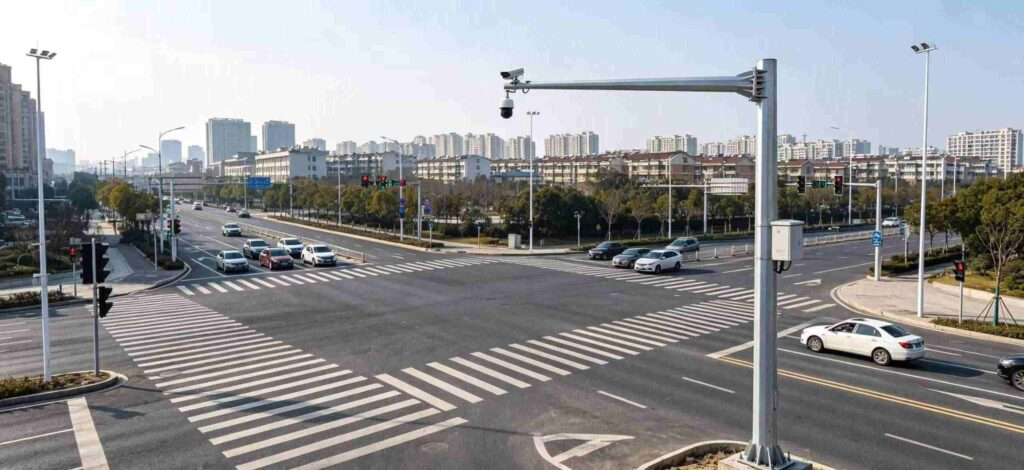
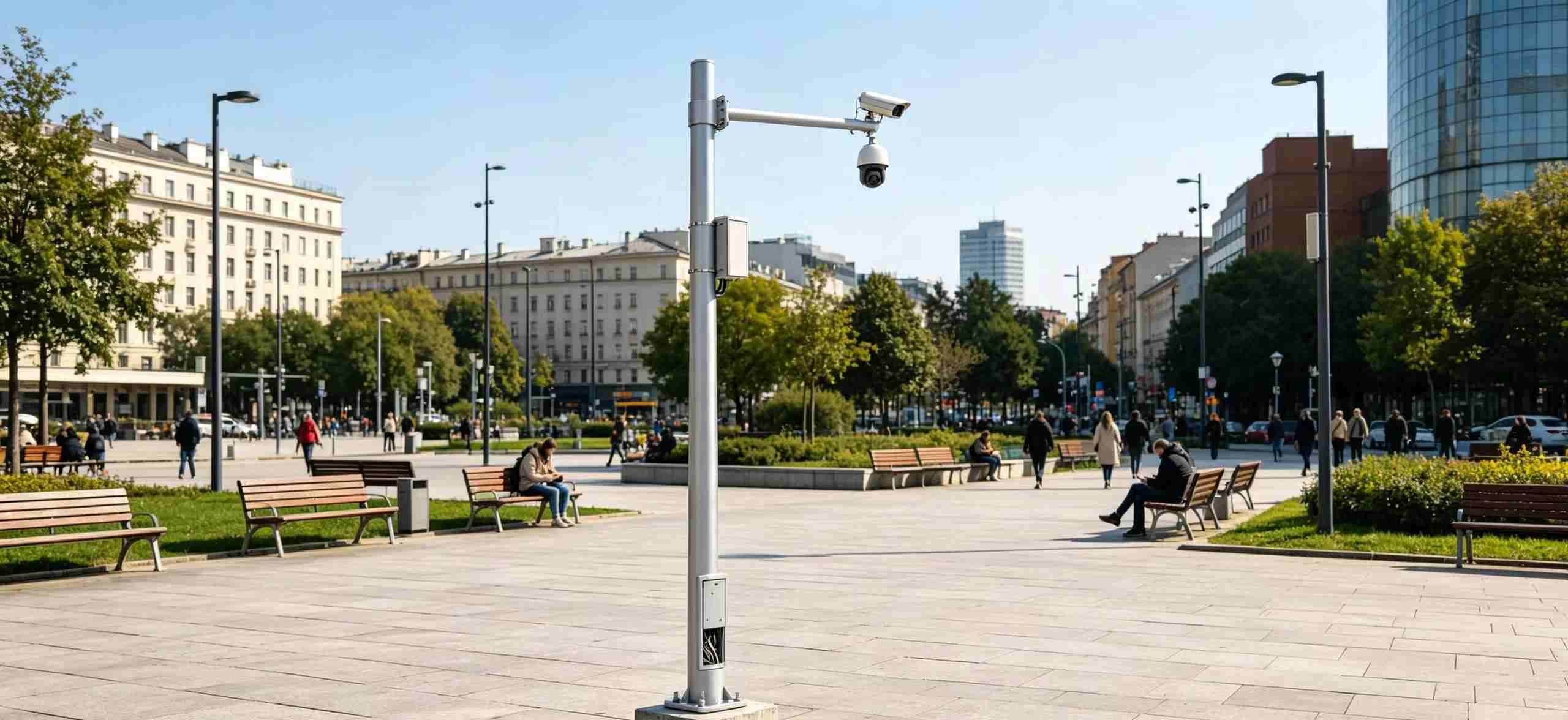
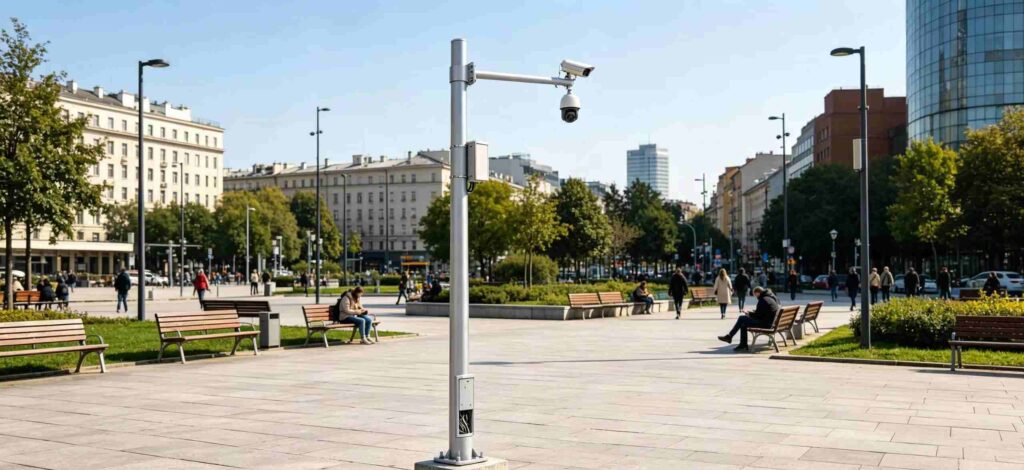
Galvanized steel is often seen as the best material for outdoor CCTV setups. It gives high strength, good load capacity, and steady structure to every mount. Hot-dip galvanizing adds a zinc layer that fights rust for years. That mix works well for permanent sites where the pole must keep its shape through wind, rain, and daily vibration.
Steel also fits standard camera brackets, tenons, equipment arms, junction boxes, and mounting assemblies without special adapters. This wide compatibility keeps design and installation simple. Morelux Steel Poles is one example maker with more than 15 years of experience in custom steel pole solutions. The company uses hot-dip galvanizing, powder coating, and duplex coating systems to extend outdoor service life.
How Steel Poles Support Permanent Outdoor CCTV Installations
Steel grade matters as much as the coating. Common structural steels for poles include Q345B, S355JR, and A572 Gr50. Their minimum yield strengths sit close together, at 345 MPa, 355 MPa, and 345 MPa respectively. Tensile strength ranges from 450 to 630 MPa across the three grades, and elongation at break stays at or above 21 percent. These properties give a CCTV pole the stiffness to hold a camera steady.
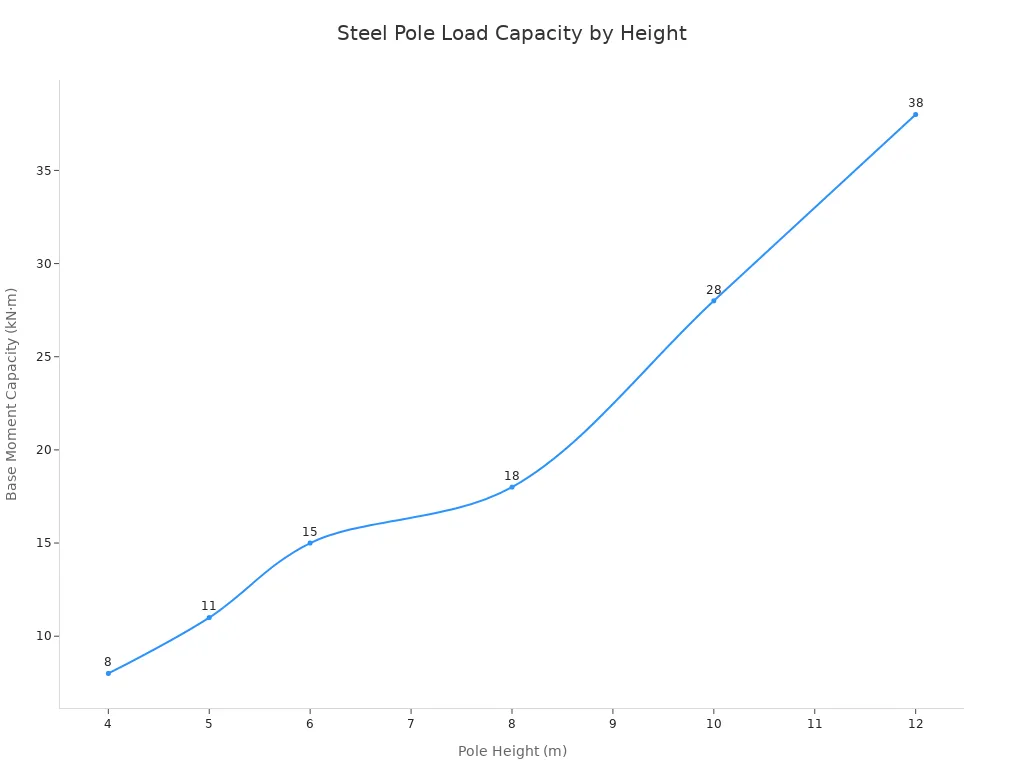
Load capacity combines two forces. Vertical load covers the dead weight of mounted equipment, typically 30 to 120 kg. Horizontal wind load is expressed as a base moment in kN·m. A well-designed 8-meter pole with a 160 mm base diameter and 5 mm wall thickness can hold a tip load of 80 kg and a base moment of 18 kN·m. That is enough for most smart-city monitoring setups.
Base moment capacity rises with pole height:
| Pole Height (m) | Base Moment Capacity (kN·m) |
|---|---|
| 4 | 8 |
| 5 | 11 |
| 6 | 15 |
| 8 | 18 |
| 10 | 28 |
| 12 | 38 |
Load Bearing: Up to 60kg equipment load
When Aluminum, Fiberglass, and Carbon Fiber Poles Make Sense
Aluminum works for direct-buried and light-duty uses, and it has a strong track record. It resists corrosion, weighs little, and needs low maintenance. Coastal areas, regions with road salt, and sites that need fast handling all favor aluminum.
Composite fiberglass does not rust. It fits sites with salt, irrigation, persistent moisture, fertilizers, or chemicals that raise corrosion concerns. Carbon fiber poles serve niche cases where low weight and high stiffness both matter, though cost limits wider use.
Wood remains a low-cost option for utility-style, rural, agricultural, equipment yard, and perimeter installations. Each material has a place. Steel still leads for heavy cameras, tall poles, and long service life.
How Do Steel and Aluminum CCTV Poles Compare in Performance?
Steel and aluminum both work well for mounting cameras, but they act differently under load. The difference shows up in strength, weight, and stiffness. Each trait affects how a pole performs on site.
How Steel Pole Strength Supports Heavy Cameras and Mounting Loads
Steel holds more load for each unit of cross-section. A steel camera pole made from 4-inch square 11-gauge commercial grade steel reaches a minimum yield strength of 50,000 psi at 30 ft of height. Aluminum poles made from 6005-T5 aerospace alloy are rated for yield strength up to 35,000 psi. So steel has a clear edge when the mount carries heavy camera heads, long arms, or stacked equipment.
Wind capacity tells a similar story. Heavy-gauge 4.75-inch square steel poles handle equipment weights up to 75 lb and wind gusts up to 170 mph. Similar extruded 6063 aluminum lowering poles are rated to 150 mph. A duty-class rating makes the same point in another form:
| Duty Class | EPA Rating | Capacity (at 100 MPH) |
|---|---|---|
| Standard Duty | 13 EPA | 234 lb |
| Medium Duty | 27 EPA | 344 lb |
| Heavy Duty | 35 EPA | 534 lb |
Higher duty classes need more structural capacity. Steel meets that need with less material.
How Pole Weight and Rigidity Affect Installation and Camera Stability
Weight works both ways. Aluminum poles weigh about one-third of a similar steel pole. That difference makes transport, handling, and installation easier, and it cuts labor time on site. Steel poles need lifting equipment and more crew effort.
Rigidity favors steel. Steel has a higher modulus of elasticity, so it bends less under wind load. Aluminum has a lower modulus and sways more in high winds. A swaying pole blurs footage and puts stress on camera mounts. Steel suits heavy fixtures and very high-wind zones. Aluminum fits lighter loads where easy handling matters most. Match the material to the load, and the CCTV pole will stay steady for years.
How Does the Installation Environment Affect CCTV Pole Material Choice?
Where a pole is placed decides how long it will last. Moisture, salt, wind, and camera height all affect the choice. A pole that works well in an inland yard may break down fast at a shoreline.
How Humidity, Coastal Air, and Road Salt Affect Steel Pole Corrosion
Salt and moisture harm steel when they act together. At a coastal container terminal, half the poles rusted through near the base within eight years. Saltwater mist, about 80% humidity, and a missing zinc layer all worked together to cause that slow failure. The zinc layer matters because it corrodes first and protects the steel below. Galvanized steel poles passed a 1,000-hour salt-spray test without red rust in salty coastal air.
| Environmental Factor | Effect on Steel CCTV Poles |
|---|---|
| Coastal air (high humidity + airborne salt) | Shortens pole lifespan because moisture and salt promote corrosion |
| Road salt (used to melt snow and ice) | Creates additional corrosion concerns for steel poles in these areas |
Structures within one mile of the shoreline face heavy chloride deposits. Galvanized steel exposed to salty winds may show rust within 5–7 years. Sheltered areas can last 15–25 years longer. A duplex system of powder coating over galvanizing often lasts more than 1.5 times the sum of the two individual lives. In coastal zones, a duplex system of paint or powder coating over galvanizing is recommended, and pairing it with 316 stainless steel fasteners adds more protection.
How Wind Exposure and Camera Height Influence Pole Material Selection
Wind load grows with camera height and exposed surface area. Tall poles on open ground need stiffer material to limit sway. Steel’s higher modulus keeps the camera steady. FRP poles offer a natural high strength-to-weight ratio, and they do not conduct electricity and need little maintenance. Concrete poles give the most rigidity for fixed sites, but they are heavy and costly to install. Match the material to the wind zone and the mounting height, and the CCTV pole will hold steady for years.
What Specifications Matter When Choosing a Steel CCTV Pole?
Two numbers drive most steel pole decisions: height and wall thickness. Both shape how the pole carries load. Both also set the cost.
How Pole Height and Wall Thickness Affect Structural Performance
A taller pole means a bigger bending force at the base. It also puts more surface out in the wind. Wall thickness controls how much stress the steel can take before it bends too far. Thicker walls add stability and carry heavier mounted loads. They also handle repeated shaking from wind and traffic. In humid or sea air, rust slowly eats away steel thickness, so a heavier wall keeps a safety margin for longer.
| Pole Height | Typical Wall Thickness | Typical Application |
|---|---|---|
| 5–6 m | 2.5–3.0 mm | Residential paths, small local roads |
| 7–9 m | 3.0–3.5 mm | Municipal streets, parking areas |
| 10 m and above | 4.0–5.0 mm | Highways, industrial roads, exposed sites |
Octagonal poles run from 3 to 12 m in Q235 or Q345 steel. Round tube poles span 2 to 10 m, with diameters from Ø60 to Ø168 mm and walls of 2 to 5 mm. Wood is the budget choice: a pressure-treated 4×4 post set in concrete works for a DIY CCTV pole, as long as it is strong enough for a ladder lean during servicing. Use galvanized carriage bolts near the bottom. Composite and specialty poles serve large properties and public areas, where tall heights are common.
How Camera Weight and Wind Loads Determine Pole Design Requirements
Every mounted item adds dead weight and effective projected area, or EPA. EPA equals projected area times drag coefficient. Wind force then goes up with velocity pressure, gust factor, force coefficient, and projected area. Loads placed higher or farther out create a larger bending moment. Shaft diameter and wall thickness follow from that demand, along with height, openings, deflection limits, and corrosion allowance.
Confirm the EPA, weight, extension length, and orientation of every arm, camera, and bracket. Check the combined total against the manufacturer’s wind-load table. The pole, base plate, anchor bolts, and foundation must work as one load path. Adding cameras later without a fresh review voids the original wind-load check.
How Base Plates and Anchor Bolts Support Secure CCTV Pole Installation
Base plates and anchor bolts transfer loads from the steel CCTV pole to its foundation. Their dimensions, bolt arrangement, and connection strength must match the pole design and expected wind loads.
Before installation, confirm the base plate thickness, anchor bolt pattern, foundation requirements, and site conditions. MORELUX provides technical drawings and structural calculation support to help coordinate pole specifications with project installation requirements.
What Common Mistakes Should Buyers Avoid When Selecting CCTV Pole Materials?
Three things drive every material choice: the environment, the load, and the pole height. A coastal yard, an industrial plant, and an inland car park each need different rust protection. A heavy stack of cameras needs more strength than a single dome. A tall pole needs more stiffness than a short one. Buyers who skip this analysis often pay for it later.
| Material | Strength | Durability | Cost | Weight | Maintenance | Environmental Resistance |
|---|---|---|---|---|---|---|
| Steel (galvanized) | High | Long | Moderate | Heavy | Low | Good with coating |
| Aluminum | Moderate | Long | Higher | Light | Low | Strong in salt air |
| Fiberglass | Moderate | Long | Moderate | Light | Low | Does not rust |
| Concrete | Very high | Very long | High | Very heavy | Very low | Strong |
| Wood | Low | Short | Low | Moderate | High | Poor without treatment |
Good steel poles are designed and tested to international standards such as BS EN, AASHTO, AS/NZS, and MS specifications. That testing gives buyers a baseline they can check.
How Ignoring Corrosion Protection Can Increase Long-Term Maintenance
A reliable specification should state the corrosion exposure outright, next to structural requirements, maintenance access, and delivery tolerances. Leaving it out is a documented oversight. Buyers should also confirm that fasteners, doors, brackets, and anchor bolts share compatible corrosion protection. A mixed-material assembly can fail at one small interface, so mismatched coatings quietly shorten pole life.
Light poles should undergo maintenance and inspection two to four times annually. In corrosive settings such as coastal regions, high-wind areas, or severe weather zones, inspections should be conducted more frequently than this baseline.
Why Camera Weight and Mounting Accessories Must Be Included in Design
Underestimating the total load is a common and costly error. Watch for these traps:
- Overlooking added accessories such as signage or cameras is a common mistake when approving poles.
- Teams often confirm pole height and fixture wattage but fail to verify the luminaire’s projected area or the full effect of outreach and double-arm configuration, resulting in a higher-than-expected wind moment.
- A pole that looks acceptable on paper may still fail if the actual top load is higher than assumed; checks should include banners, cameras, signs, or added attachments.
- If EPA or outreach is missing or guessed, the pole review is incomplete.
Ignoring accessories is a primary mistake. A pole with a compact luminaire can pass easily, yet the same pole may fail once a camera bracket or banner arm is added. Smart poles compound this risk. Cameras, antennas, sensors, and speakers each add projected area or concentrated weight, and some introduce vibration or service access needs. The pole becomes a multifunction utility node. The team must assess whether it can support an evolving load stack over time. If a city later adds a 5G unit, sensor pod, or second arm, the original certification may no longer be sufficient. Size the CCTV pole for the load it will carry, not the load it carries today.
Our Custom Steel CCTV Pole Solutions for Outdoor Security Projects
MORELUX manufactures custom steel CCTV poles for infrastructure and security projects worldwide. The company supports customized designs, technical drawings, engineering calculations, and project-specific quotations.
How MORELUX Customizes Steel Pole Dimensions and Mounting Configurations
Buyers can specify pole height, shaft shape, wall thickness, mounting brackets, access doors, cable openings, and foundation requirements. Site conditions and the number of mounted devices also influence the design.
| Project Scenario | Configuration Considerations |
|---|---|
| Multiple devices on one pole | Mounting interfaces and cable routing |
| Smart city applications | Coordinated brackets for cameras, sensors, and lighting |
| Coastal or high-wind sites | Structural calculations and suitable corrosion protection |
| Special project requirements | Customized dimensions, base plates, and access openings |
Project-specific drawings help confirm dimensions, mounting arrangements, and installation requirements before production.
How Engineering Calculations and Galvanizing Support Project Requirements
Structural calculations consider wind speed, pole height, camera loads, and mounting configurations to determine suitable dimensions and anchoring requirements.
Hot-dip galvanizing provides corrosion protection for outdoor steel CCTV poles. Additional powder coating or paint can offer further protection against weather exposure. MORELUX provides customized steel poles with protective finishes selected according to project specifications.
The right design depends on the installation environment, structural loads, and maintenance requirements. Confirming these factors before ordering helps buyers select a suitable steel CCTV pole for long-term outdoor use.
Frequently Asked Questions About CCTV Camera Pole Materials
Is Steel or Aluminum Better for Permanent Outdoor CCTV Camera Poles?
Steel offers high structural strength for heavier cameras and demanding installations. Aluminum is lighter and naturally corrosion-resistant. The best choice depends on camera loads, wind conditions, budget, and maintenance requirements.
Are Galvanized Steel Poles Suitable for Outdoor Security Cameras?
Yes. Hot-dip galvanized steel CCTV poles provide corrosion protection against moisture and outdoor exposure. MORELUX offers galvanizing to ISO 1461 requirements, with additional coatings available for demanding environments.
How Tall Can a Steel CCTV Pole Be for Security Camera Installation?
The required height depends on camera coverage, viewing angles, site layout, and wind loads. MORELUX manufactures customized steel poles from 4 m to 45 m for different applications, with final height determined by structural and project requirements.
How Do I Choose the Right Steel Pole for Camera Weight and Wind Loads?
Consider pole height, steel grade, wall thickness, camera weight, mounting brackets, and effective projected area (EPA). Local wind conditions and foundation design also affect stability. MORELUX provides structural calculations and wind load analysis to support project-specific pole selection.