Camera pole safety keeps people, property, and equipment safe. A CCTV pole holds real weight and live power above public spaces. Bad planning or weak hardware can turn that structure into a danger.
Five safety steps matter most. Site planning sets clearances and load limits. Structural integrity covers the pole, base, and fasteners. Electrical safety covers grounding, surge protection, and cable routing. Fall protection controls work at height. Operational safety covers inspection, maintenance, and safe use of access features.
The right steps prevent accidents, structural failures, and electrical hazards. Each step supports the others. A strong pole on a weak foundation still fails. Correct grounding without cable protection still wears down. Safety starts before installation and continues through every service visit.
Key Takeaways
- Plan the site carefully to set clearances and load limits before installation.
- Build a strong structure with good foundations and hardware to prevent failures.
- Ground and protect electrical systems to prevent shocks and damage to equipment.
- Use fall protection and safe access when working at heights.
- Check and take care of poles on a regular basis to keep them safe over time.
What Site Safety Precautions Should Buyers Follow for CCTV Poles?
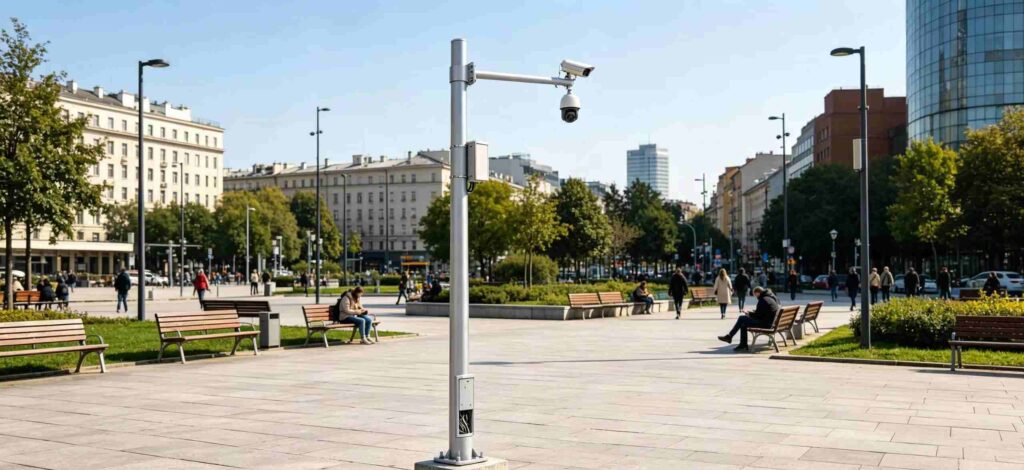
Site planning comes first. Before installing, you should decide on the area to watch, the camera type, the mounting height, the camera layout, and the installation method. These choices set the load case for the pole. A taller pole with more cameras carries more weight and catches more wind. Buyers who skip this step often order a pole that is too short, too light, or badly placed.
How Site Inspections Identify Hazards Before CCTV Pole Installation
A site inspection finds hazards before any hole is dug. Inspectors check soil conditions, slope, drainage, and nearby trees or buildings. They also check access for lifting equipment and service vehicles. Soft ground or poor drainage can weaken a foundation over time. A slope can shift the load on the base. Trees can block camera views and drop limbs onto the pole.
Wind load and weight load deserve close attention. Camera poles must handle wind loads because the top of a pole can move a lot in the wind. The pole must also account for the weight of cameras, brackets, and mounting equipment. Pole height, base design, power supply, and placement must be planned around real job site conditions, not catalog assumptions.
Material choice affects installation requirements. Available pole options include steel, fiberglass, and wood, and each has different installation needs. Aluminum poles suit corrosion-resistant, lighter-load areas. Steel poles carry heavier loads and taller camera stacks. Morelux steel poles are designed and tested to BS EN, AASHTO, AS/NZS, and MS standards, and the engineering team provides wind load analysis and structural calculations for each project.
How Roadside Clearances and Underground Utilities Affect Pole Safety
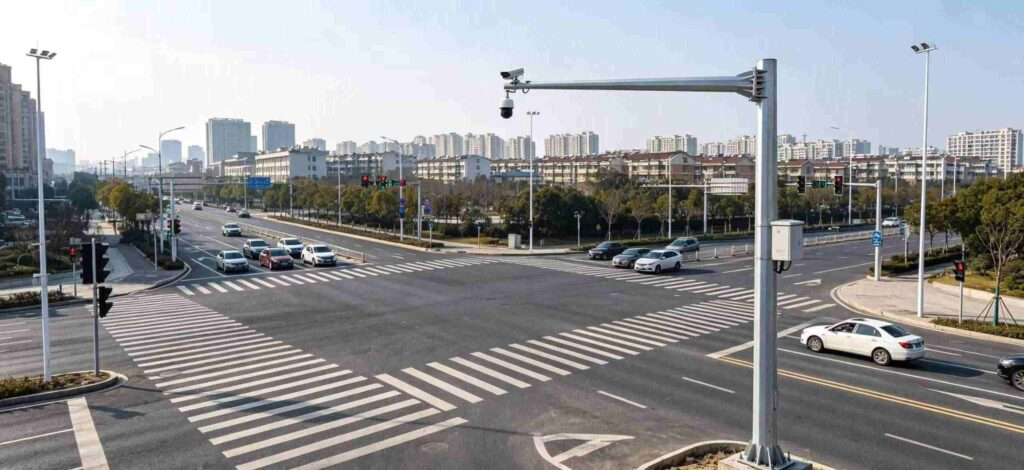
Roadside poles need clear zones. The pole base should sit far enough from the curb and travel lane to protect the structure from vehicle strikes. The camera arm should not overhang traffic in a way that reduces clearance for tall vehicles. Service doors should face away from traffic where possible, so technicians can work without standing in a live lane.
Underground utilities are the other hidden risk. Gas, water, power, and telecom lines often run close to the curb line. A foundation excavation can hit a buried line and cause injury, outage, or costly repair. Buyers should get utility drawings and arrange a locate survey before excavation. Hand digging near marked lines is safer than machine digging.
Clearance planning also covers sight lines and public access. A pole placed too close to a walkway invites climbing and vandalism. A pole placed too far from the target area weakens camera coverage. The right position balances coverage, clearance, and service access. This single decision shapes the safety of the whole CCTV pole installation.
How Can Buyers Ensure CCTV Pole Stability in Outdoor Conditions?
Stability in outdoor conditions depends on three connected parts: the pole structure, the foundation system, and the hardware that joins them. A weak link in any part weakens the whole assembly. Buyers should treat stability as an engineering question, not a catalog choice. Each part must be sized for the real site, not a generic guess.
How Steel Pole Height and Wind Loads Affect Structural Stability
Wind load analysis follows AASHTO LRFD standards for camera and CCTV pole design. Engineers use a fixed baseline of 110 MPH to stay on the safe side, plus a 1.2 drag coefficient. The Effective Projected Area is figured for solar panels, NEMA enclosures, and security hardware. Pole wind load equals 0.613 times frontal projected area times drag coefficient times wind speed squared. Round poles usually have a lower drag coefficient of about 0.85 to 1.00. Square poles reach up to 1.20 because flat faces and sharp edges create turbulence. Round tapered steel poles work well at high-wind sites because of their aerodynamic shape, structural tapering, and 55,000 psi yield strength. Steel, fiberglass, and wood poles are often rated for 130 mph to 160 mph, depending on EPA, wind zone, height, and material. These calculators do not account for dynamic gust factors, site shielding, or soil conditions, so high-risk sites need final structural validation.
Height changes the load case. Cameras can handle much less top-of-pole sway than light heads, and a full camera package can weigh much more. The base, not the visible height, is usually the failure point in storms. A taller pole with a heavier camera stack needs a larger diameter and more reinforcement at the base. A 75-ft highway CCTV specification includes lowering devices so cameras can be serviced at ground level. Material choice follows height and load. Steel works for taller poles over 20 to 25 ft in large lots and high-wind areas. Aluminum works for lighter loads that need corrosion resistance. Buyers should check the pole’s EPA table, since underestimating load or wind capacity causes structural failure.
How Foundations, Base Plates, and Anchor Bolts Support CCTV Poles
A foundation engineer sizes the concrete using soil type, wind zone, pole height, and total top load. Recommended concrete form sizes vary by pole line. The 4-inch square steel pole line and SteadyMax SP-SM12 and SP-SM16 use 18-inch by 5-foot StrongForms. SteadyMax SP-SM20 uses 24-inch by 5-foot forms. SteadyMax SP-SM25 uses 30-inch by 6-foot forms. Anchor length runs 18 to 36 inches, with bolt projection of 2 1/4 to 2 3/4 inches. Anchor baskets arrive pre-assembled with a hot-dipped galvanized anchor cage, positioning plate, washers, and hex nuts. Installers push the basket into wet concrete until the template sits flush, keep conduit above the template hole, remove the wooden template after curing, then install the pole.
Regular inspection protects stability over time. Check for leaning, corrosion, and loose fittings on poles, mounts, and hardware. A pole that leans slightly after a storm needs quick attention. Loose anchor nuts should be re-torqued to the engineer’s specification. Surface treatment durability matters. Hot-dip galvanizing, powder coating, and duplex coating systems resist corrosion. Morelux offers square, tapered, round, tubular, octagonal, hexagonal, straight, curved, single-arm, and double-arm pole structures to match site needs.
What Electrical Safety Measures Are Needed for Outdoor CCTV Poles?
Electrical problems on an outdoor camera pole can hurt technicians and ruin equipment. Cables should run inside the camera pole through PVC or metal conduits. This routing protects them from rain, sunlight, rodents, and physical damage. Exposed cable on a mast wears out fast and lets moisture into the connections.
How Grounding and Surge Protection Help Protect CCTV Pole Systems
Grounding gives fault current a safe path to earth. A detached pole should bond back to the building’s main ground electrode, not sit as an isolated island. An ungrounded metal pole acts like an antenna for surge energy. Grounding alone does not stop surges, though. Protection devices clamp the spike, and the ground path carries the energy away. Both parts must work together.
- Single-point grounding ties surveillance gear to the same electrode system as the building service.
- Metal conduit stays continuous and bonded at entry points.
- Surge protection works in layers: service entrance, inline Ethernet protectors at the switch, and camera-end devices for runs over fifty feet.
- A PoE switch with surge suppression adds another buffer.
Replace surge modules after a major strike or when indicator lights show failure. Many units sacrifice themselves to save downstream gear.
How Cable Routing and Utility Clearances Reduce Electrical Hazards
Keep power and data runs short and away from high-risk metal paths. Use UV-resistant outdoor cable with drip loops, and seal every penetration with listed fittings. Fiber isolation suits long runs, separate grounding systems, or exposed masts, because it stops surge energy at the media converter.
Service work demands discipline. Turn the camera off and unplug the power cable before any maintenance. For cabinet-based CCTV pole designs that tilt over, follow the manufacturer’s procedure: clear the tilt zone, confirm the latch engagement, and lower the assembly slowly with the cabinet secured.
How Should Buyers Inspect and Maintain CCTV Poles for Safety?
Inspection keeps a CCTV pole safe for its whole life. Maintenance work itself is risky, so technicians need personal protective equipment for working at heights. A hard hat, safety harness, and anchored lanyard are basic requirements. Gloves and eye protection guard against sharp edges and coating debris.
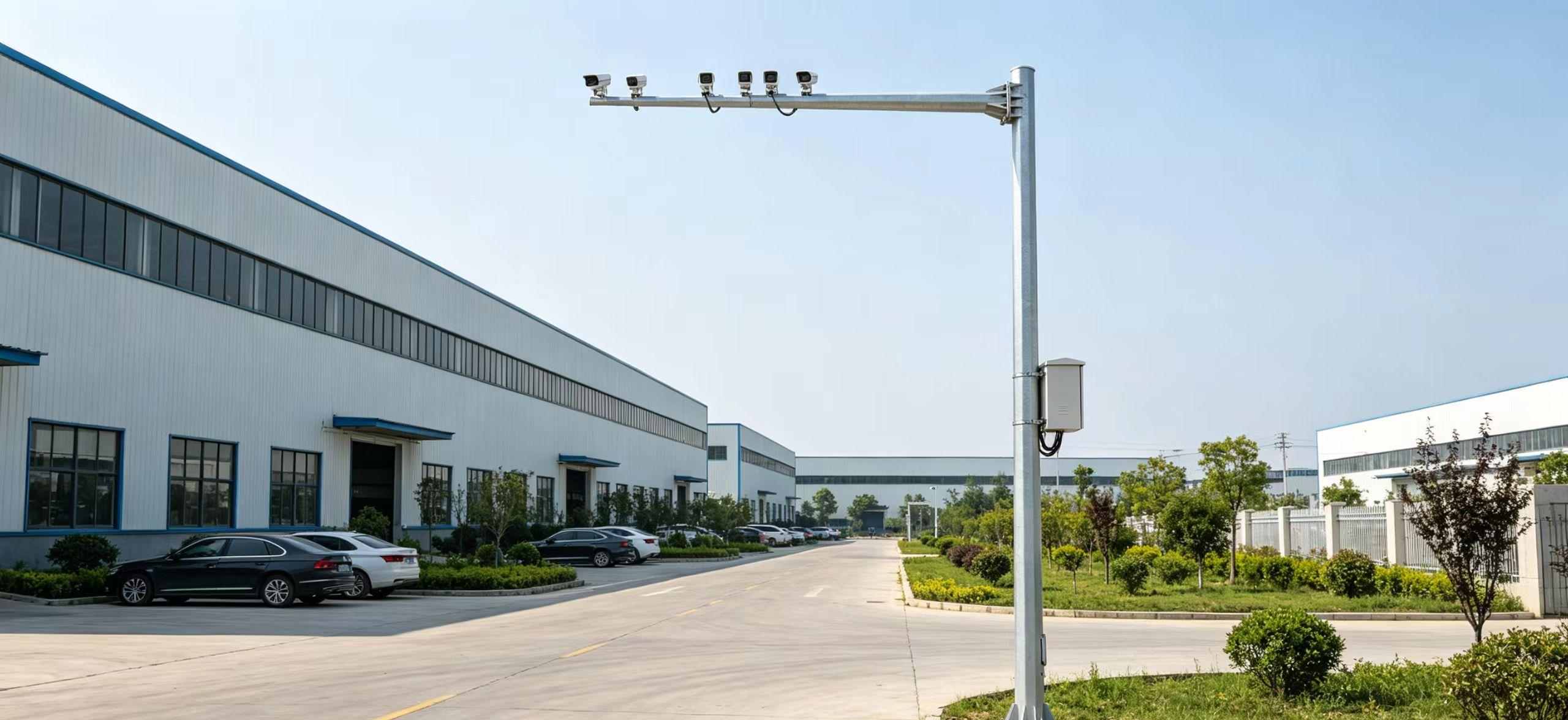
Safe access matters as much as the inspection. Climbing rung poles give technicians a built-in ladder with steady footing. Mid-hinged poles let the upper section lower to the ground, so most checks happen without a climb. Telescopic camera poles need their own routine. Set up the tripod base firmly before extending the pole, and check every quick-release clamp for proper engagement before use.
How to Inspect Steel Poles for Corrosion, Cracks, and Loose Fasteners
Start by classifying the exposure environment. Coastal salt, deicing salt, industrial pollution, humidity, and standing water all raise corrosion risk. Then follow the water. Check for blocked drains, open-ended members, failed seals, and details that trap moisture against the base.
Work through the discontinuities next:
- Inspect cut edges, weld zones, fasteners, access doors, hinges, base plates, and arm connections.
- Check dissimilar metals for compatibility issues when moisture and an electrical path are present.
- Document any section loss by location, dimensions, and depth, and separate surface staining from measurable metal loss.
- Verify the pole is plumb and the base plate shows no distortion, cracks, or separation.
- Confirm anchor bolts are straight and tight, and re-torque the nuts at least once a year per the recommended minimum torque rating.
- Check grout integrity and confirm water drains away from the base.
- Escalate to qualified personnel for structural assessment when visual inspection cannot confirm soundness.
How to Check Camera Mounts, Cable Entries, and Pole Access Doors
Inspect arms and brackets for metal fatigue, including cracks caused by vibration, corrosion, or constant stress. Avoid adding cameras, banners, or signs unless the pole was designed for the extra wind load. Confirm the top cap is tight and present.
Cable entries deserve close attention. Look for damaged conduit, exposed conductors, and failed seals around every penetration. Confirm handhole covers, base covers, and pole top covers are firmly attached to keep out dust and moisture. Check access doors for secure latches and dry cavities. Record impact marks, settlement, or pavement movement near the base, and recoat any surface scratches to maintain protection.
Our Custom Steel CCTV Pole Solutions for Safer Installations
How MORELUX Customizes Steel CCTV Poles for Site-Specific Requirements
MORELUX provides customized steel CCTV poles based on local wind conditions, soil properties, corrosion exposure, and installation clearances. Hot-dip galvanizing and additional protective coatings can help improve durability in humid and coastal environments.
Pole placement should also maintain safe distances from traffic and walkways, provide sufficient vehicle clearance, and allow convenient maintenance access.
How Structural Calculations and Quality Control Support Pole Safety
Safe CCTV pole installations require structural calculations, suitable foundations, and secure anchor bolts. MORELUX provides engineering support and technical drawings to help meet applicable standards, including BS EN, AASHTO, AS/NZS, and MS requirements.
After installation, regular inspections should check for corrosion, loose anchor bolts, foundation movement, and structural damage. Any additional cameras or attachments should undergo a load assessment to ensure the pole remains structurally safe.
Frequently Asked Questions About CCTV Pole Safety Precautions
Do CCTV Poles Need Grounding and Lightning Surge Protection?
Yes. Outdoor steel CCTV poles should have appropriate grounding and surge protection to reduce electrical hazards and protect connected cameras. Requirements depend on local electrical codes, lightning exposure, and system design.
How Often Should Outdoor Steel CCTV Poles Be Inspected?
Inspect steel CCTV poles periodically and after severe weather. Check for corrosion, loose anchor bolts, foundation movement, damaged coatings, and structural deformation. Inspection frequency should reflect site conditions and maintenance requirements.
Can Strong Winds Make a CCTV Pole Unsafe?
Yes. Strong winds can cause excessive deflection or structural failure if the pole is not designed for the site’s wind loads. Pole height, wall thickness, camera weight, mounting brackets, and foundation strength all affect stability.
What Safety Checks Are Needed Before Installing a CCTV Pole?
Before installation, verify underground utilities, soil conditions, foundation dimensions, anchor bolt alignment, and structural drawings. Confirm that the pole meets applicable standards and that camera loads and local wind conditions have been assessed. Ensure safe clearance from traffic and pedestrian areas.